
Wine
Organic Wine Labels: EU Logo, E-Label and QR Codes
How EU organic labelling and wine e-label rules fit together: what stays on the bottle, where the organic logo goes, and what can sit behind a QR code.
By Ali Murtaza ·
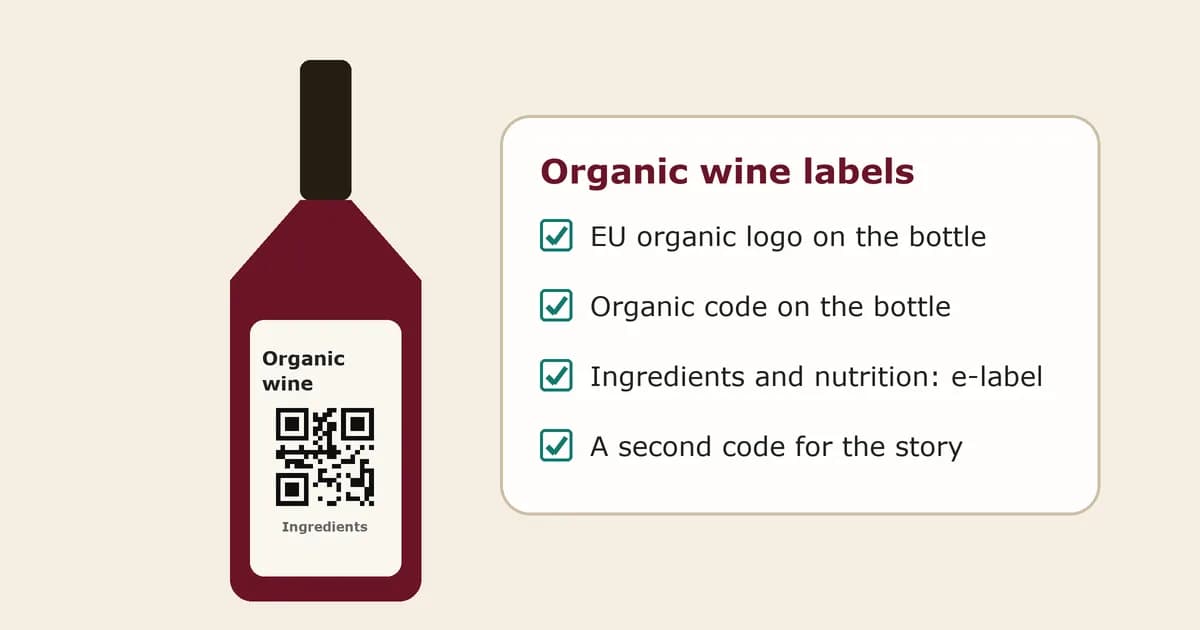
Organic wineries face two sets of EU labelling rules at once. The wine rules decide what has to appear on the bottle and what can move behind a QR code. The organic rules decide how the EU organic logo, the control body code and organic claims are shown. This guide explains how the two fit together on a modern back label with an e-label, and what organic producers should check before the next print run.
Plain-language guidance, not legal advice. Check the regulations linked below and your control body's guidance for your own wines.
The wine rules in short
Since 8 December 2023, wine placed on the EU market must give a list of ingredients and a nutrition declaration (Article 119 of Regulation (EU) No 1308/2013, as amended by Regulation (EU) 2021/2117). Both can be provided by electronic means, usually a QR code, as long as the energy value and any allergens stay printed on the bottle, the e-label page carries no sales or marketing information, and no user data is collected or tracked. Organic wine follows exactly the same rules here. Being organic does not exempt a wine from the ingredients list or the nutrition declaration.
Source: European Commission Q&A on the EU wine labelling provisions (EUR-Lex).
The organic rules in short
Organic production and labelling in the EU are governed by Regulation (EU) 2018/848. For prepacked organic products made in the EU, the EU organic logo is mandatory. Where the logo is used, the code number of the control body or control authority and an indication of where the agricultural raw materials were farmed (for example "EU Agriculture") must appear in the same visual field as the logo. Specific winemaking rules for organic wine, including which oenological practices and substances are allowed, sit in the organic regulation and its implementing acts.
Source: Regulation (EU) 2018/848 on organic production and labelling (EUR-Lex).
What must stay printed on an organic wine label
Putting the ingredients and nutrition details online frees up a lot of space, but some items cannot move. For an organic wine sold in the EU, plan to keep these on the physical label:
- The usual compulsory wine particulars, such as the category, alcoholic strength, net volume, origin and bottler details.
- The energy value, per 100 ml, which may be shown with the symbol "E".
- Allergens such as sulphites, and egg or milk when they have to be declared.
- The EU organic logo, with the control body code and the place of farming indication in the same visual field.
- The QR code itself, with a heading that includes the word "ingredients" when the code leads to the ingredients list, in the same field of vision as the other compulsory particulars.
The organic logo and its code cannot live only on the e-label. They are part of the physical labelling, and buyers, retailers and inspectors look for them on the bottle.
Organic claims on the e-label page
The e-label page carries the ingredients list and the nutrition declaration. Under the organic rules, ingredients from organic production can be identified in the ingredients list, for example with a marker that refers to a note saying they are organic. That is information about the product, not marketing, so it fits on an e-label page.
Longer organic storytelling is different. Text about your vineyard practices, biodiversity, certifications history or why you converted to organic is valuable, but it is promotional in nature. The Commission's guidance says the e-label page must not be shown with sales or marketing information. Keep that story on a separate page reached by a separate code, which is why many wineries now use a two-QR back label: one code for the legal e-label and one for the brand story.
Sulphites and organic wine
Organic wine is not sulphite-free by default. EU organic rules set lower maximum sulphite levels than conventional wine, but most organic wines still contain sulphites above the 10 mg/l threshold, so "contains sulphites" (or the equivalent in the language of the market) still has to be printed on the bottle. If you make a wine with no added sulphites, check your analysis before dropping the allergen statement, because sulphites also form naturally during fermentation.
A simple layout for an organic back label
Here is a layout that works for many organic producers selling in several EU markets:
- Printed block: compulsory particulars, energy value, allergens, and the EU organic logo with its control body code and place of farming.
- First QR code, labelled with the word "ingredients": the legal e-label page with the ingredients list (organic ingredients marked) and the full nutrition declaration, in the languages of your markets, with no tracking and no shop links.
- Second QR code, outside the legal block: your organic story, tasting notes, food pairings and a reorder option.
Keeping the two codes apart makes it easy to show an inspector that the e-label is clean, while still giving curious buyers somewhere to go next.
How Tapline fits
Tapline is built by Esipick, a software company around since 2013. For the brand-story side of the label, Tapline gives each code a story page, a reorder button and scan counts per code, so you can see which labels and batches get scanned. Multi-language pages are available on the Scale plan. For the legal side, read our guides on the ingredients list and allergen labelling linked below, and keep the e-label page free of marketing and tracking.
See how it works for wineries on the wine page: /wine
Related guides
- Two QR codes on a wine label: /blog/two-qr-codes-on-a-wine-label
- How to write a wine ingredients list for an EU e-label: /blog/wine-ingredients-list-eu-e-label
- Wine allergen labelling: sulphites, egg and milk: /blog/wine-allergen-labelling-eu-e-label
- 10 wine e-label mistakes to fix before you print: /blog/wine-e-label-mistakes
FAQ
Does organic wine need an EU e-label?
Organic wine needs an ingredients list and a nutrition declaration like any other wine sold in the EU. An e-label behind a QR code is one allowed way to give them; printing them in full on the label is the other.
Can the EU organic logo go on the e-label instead of the bottle?
No. The organic logo, with its control body code and place of farming indication, belongs on the physical label. It can also appear on the e-label page, but not instead of the bottle.
Can I mark organic ingredients on the e-label?
Yes. Identifying ingredients from organic production in the ingredients list is product information, so it belongs on the e-label page alongside the rest of the list.
Can my organic story go on the e-label page?
Keep it separate. The e-label page must not carry sales or marketing information, so put your vineyard story, pairings and shop links on a second page or a second QR code.
Do organic wines still have to say "contains sulphites"?
Usually yes. Organic wines have lower sulphite limits, but most are still above 10 mg/l, the level at which the allergen statement is required. Check your lab analysis for each wine.