
Wine
How to Write a Wine Ingredients List for an EU E-Label
What goes in an EU wine ingredients list: grapes, additives by category and E number, yeast and fining agents, allergens, plus three example lists.
By Ali Murtaza ·
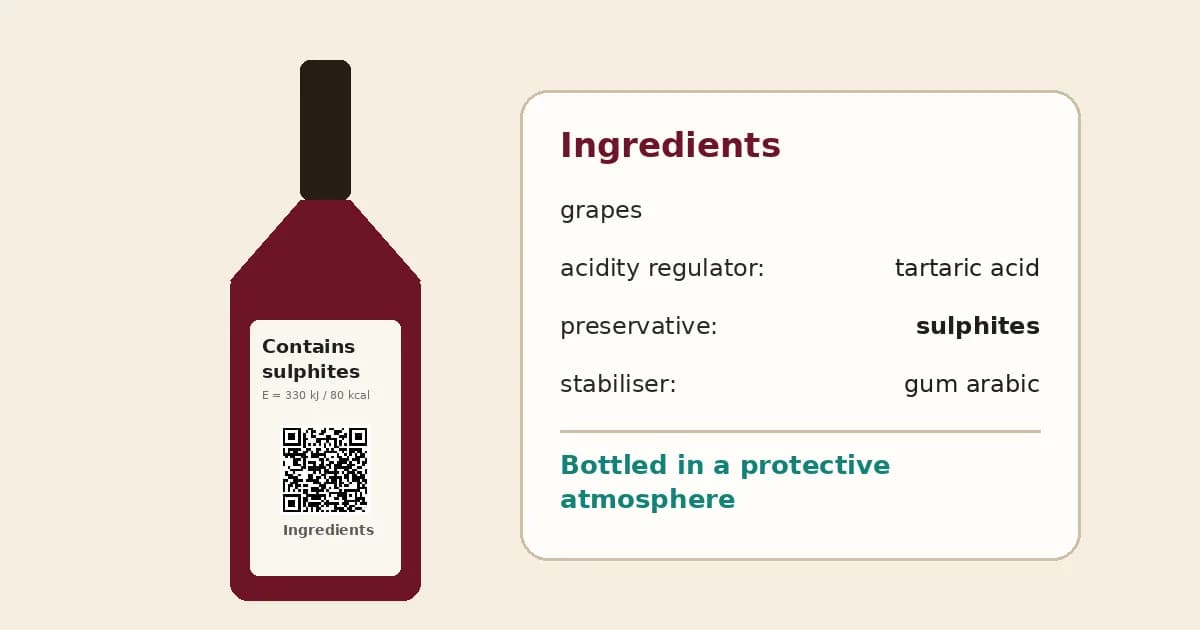
Since 8 December 2023, wine made for sale in the EU has to show a list of ingredients, either on the label or behind an "Ingredients" QR code. The rules are short, but they use winemaking terms in a very specific way, and most questions from wineries come down to the same few points: what counts as an ingredient, how additives are named, what happens to yeast and fining agents, and which words have to stay on the bottle. This guide walks through each one and ends with example lists you can adapt.
Plain-language guidance, not legal advice. Check your final list with your lab, compliance adviser or importer.
Which rules set the wine ingredients list?
Three texts do the work. Regulation (EU) 2021/2117 made the ingredients list and nutrition declaration compulsory for wine. Commission Delegated Regulation (EU) 2023/1606 added wine-specific naming rules (Article 48a of Regulation 2019/33). And Table 2 of Part A of Annex I to Delegated Regulation (EU) 2019/934 lists every additive and processing aid allowed in EU winemaking, with the exact terms and E numbers to use on the label. The Commission's question-and-answer notice on the new rules (C/2023/1190) explains how they fit together.
Wine produced before 8 December 2023 can still be sold with its old labels until stocks run out.
What has to be in the list?
The list starts with a heading that contains the word "ingredients". Ingredients appear in descending order of weight at the time they were used, so grapes always come first. Anything under 2% of the finished wine can be listed in any order after the rest. In practice a wine's list is built from five groups:
- The raw material. You can name exactly what you used (grapes, crushed grapes, grape must) or simply write "grapes".
- Enrichment and sweetening. Concentrated grape must and rectified concentrated grape must can both be written as "concentrated grape must". Sucrose must be listed separately, and you may call it "sugar".
- Every additive used, named by its functional category followed by its name or E number, for example "acidity regulator: tartaric acid" or "acidity regulator: E 334".
- Processing aids, but only those that cause allergies or intolerances and are still present in the finished wine.
- For sparkling wine, tirage liqueur and expedition liqueur, which can be listed under those names, with their constituents in brackets if you want.
How do you name additives on a wine label?
Use the functional category, then the specific name or the E number. The categories and terms to use are the ones in Table 2 of the 2019/934 annex, so copy the wording from there rather than from a supplier's data sheet. Some common examples:
| What you added | How it can appear |
|---|---|
| Tartaric acid to acidify | Acidity regulator: tartaric acid (or E 334) |
| Sulphur dioxide or potassium metabisulphite | Preservative: sulphites |
| Gum arabic | Stabiliser: gum arabic (or E 414) |
| Carboxymethylcellulose (CMC) | Stabiliser: carboxymethylcellulose (or E 466) |
| Yeast mannoproteins | Stabiliser: yeast mannoproteins |
| Nitrogen, argon or CO2 at bottling | "Bottled in a protective atmosphere" |
Two shortcuts save a lot of relabelling. First, acidity regulators and stabilising agents that are similar or can replace each other may be written as "contains … and/or …", followed by no more than three additives, as long as at least one of them is in the wine. That lets one label cover vintages where you used different products. Second, packaging gases can be replaced by "Bottled in a protective atmosphere" or "Bottling may happen in a protective atmosphere". If you use either phrase, you don't name the gases, and the phrase must sit in the same field of vision as the ingredients list.
Do yeast, bentonite and fining agents go on the list?
Usually not. Processing aids don't have to be listed, and the Commission treats yeasts used for fermentation, and other yeast products with their own technical role, as processing aids. Bentonite and most filtration aids are in the same position. The one yeast product that must be listed is yeast mannoproteins, because they are used as an additive (a stabiliser). You may still list yeasts voluntarily if you want to show them.
The exception is allergens. A processing aid that causes allergies or intolerances must be declared if it is still present in the finished wine, even in an altered form. For wine that mostly means egg-based and milk-based fining agents. Ask your lab whether residues are detectable in your finished wine; if they are, they go in the list and on the bottle.
Which allergen words must stay on the bottle?
Allergens are the one part of the ingredients list you can't move entirely online. If the full list is on the label, allergens are shown inside it and emphasised with a different typeface, such as bold. If the full list is behind a QR code, the bottle must still say "contains" followed by the allergen, for example "Contains sulphites", and the online list must emphasise them too.
The Commission asks producers to keep using the familiar terms: sulphites (or sulfites), egg and egg-based products, and milk and milk-based products. Any other allergen is named specifically, for example "wheat protein". Printed text, including the allergen line and any ingredients on the label, must be at least 1.2 mm high.
Example ingredients lists
Here are three made-up examples to show the format. Your own list must match what you actually used in each wine and vintage.
| Wine | Example list |
|---|---|
| Dry white | Ingredients: grapes, preservative: sulphites, stabiliser: gum arabic. Bottled in a protective atmosphere. |
| Red with acidification | Ingredients: grapes, acidity regulator: tartaric acid, preservative: sulphites, stabiliser: contains carboxymethylcellulose and/or yeast mannoproteins. |
| Traditional-method sparkling | Ingredients: grapes, tirage liqueur, expedition liqueur (sugar, wine), preservative: sulphites. |
In each case the bottle also needs "Contains sulphites" printed in words, plus the energy value. Our guide to calculating wine calories covers the energy figure.
Common mistakes to avoid
- Listing yeasts or bentonite as if they were required, then forgetting the additives that are. Every additive goes on the list; most processing aids don't.
- Using supplier trade names instead of the category and the term from Table 2.
- Writing "contains … and/or …" for categories other than acidity regulators and stabilising agents, or listing more than three options.
- Moving the allergen line onto the e-label page only. "Contains sulphites" stays on the bottle.
- Forgetting languages. Mandatory information must be in a language easily understood where the wine is sold, so an export wine's e-label usually needs more than one language.
- Adding marketing or tracking to the ingredients page. The page behind the e-label code must not collect or track user data, so tasting notes and a shop link belong on a second code.
FAQs
Can the ingredients list be only on the e-label?
Yes. The full list can be given electronically through a QR code on the label, as long as allergens are printed on the bottle with the word "contains" and the energy value is on the label too.
Do I have to list water?
Water isn't something most still wines add as an ingredient. If your winemaking does involve added water, check with your adviser how it should be declared under the general food labelling rules.
Does the list change every vintage?
It changes whenever what you added changes. The "contains … and/or …" option for acidity regulators and stabilisers, and the protective-atmosphere phrase, help one printed label stay accurate across small changes, but the e-label page should always match the wine in the bottle.
Can the Ingredients QR code also link to my shop?
No. The e-label page must stay neutral, without sales content or tracking. Use a separate marketing code for that; our two-QR guide shows how to place both.
Where does Tapline fit?
Tapline gives each wine its own marketing page and QR code: a story page with tasting notes, a reorder button to your own shop or stockist list, and scan counts per code, editable after printing. On the Scale plan the page can be shown in several languages for export markets. The marketing page is never the legal e-label. Tapline can also host a separate, neutral e-label page that you fill in yourself, and you are responsible for its accuracy. Tapline is built by Esipick, which has been building software for brands since 2013.
Related: what happens after the scan.
Related: EU e-label rules for wine.
Related: how to calculate wine calories for an e-label.
Related: two QR codes on one label.
Related: wine label rules for export.
Related: pricing.