
Wine
How to Calculate Wine Calories for an EU E-Label
Work out the energy value for an EU wine label from alcohol and sugar: the conversion factors, two worked examples, rounding and common mistakes.
By Ali Murtaza ·
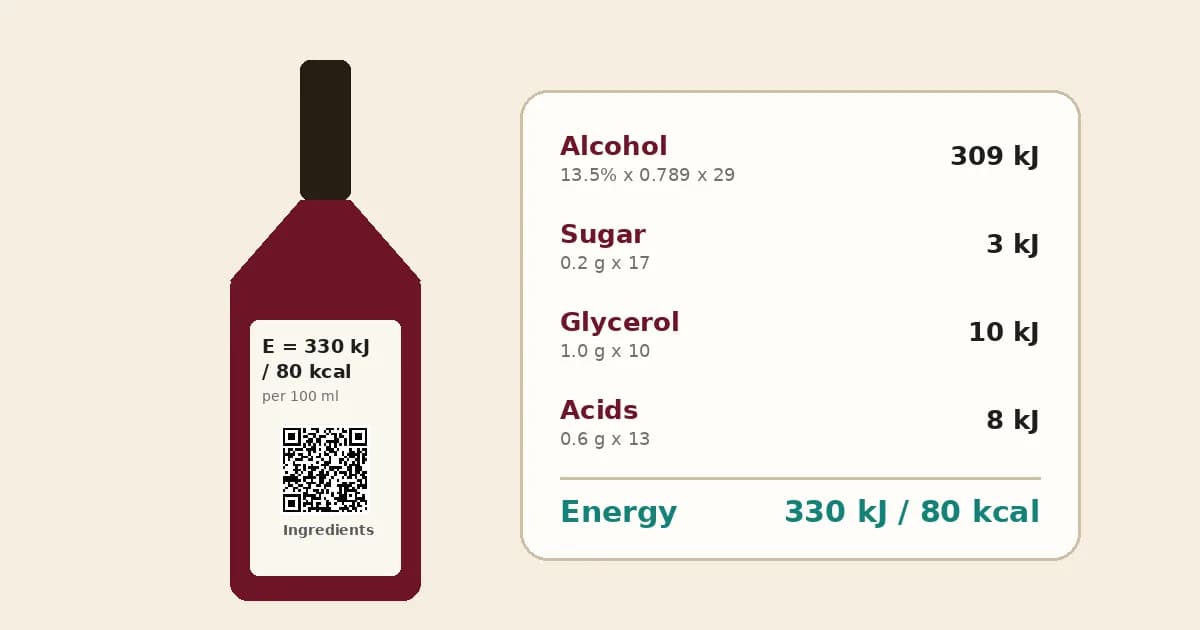
Every wine sold in the EU now carries an energy value on the bottle, and a full nutrition table either on the label or behind an "Ingredients" QR code. Most small wineries don't send every wine to a lab for this. They work the numbers out from figures they already have: alcohol, residual sugar and a couple of standard values. This guide shows the method, the conversion factors, two worked examples and the mistakes that trip people up.
Plain-language guidance, not legal advice. Check your final figures and layout with your lab, compliance adviser or importer.
What nutrition information does an EU wine label need?
Since 8 December 2023, wine produced for sale in the EU needs a nutrition declaration. The full version lists energy, fat, saturates, carbohydrate, sugars, protein and salt, all per 100 ml. The EU allows the label itself to show only the energy value, as long as the full declaration is given electronically, usually on the page behind the e-label QR code. On the label, the energy value can be written with the symbol "E" followed by the figures, for example "E = 330 kJ / 80 kcal".
The Commission's Q&A on the wine labelling rules adds that the electronic nutrition declaration should always be a table with the numbers aligned, because space isn't a problem on a web page. Energy is shown in kilojoules first, then kilocalories.
Do I need a lab test, or can I calculate it?
You can calculate it. The values in a nutrition declaration are average values, and the EU food information rules allow them to come from your own analysis, from the known average values of what went into the wine, or from generally established and accepted data. You already measure alcohol and residual sugar for every wine, and those two figures drive almost all of the energy value.
A lab is still worth using for unusual wines, such as fortified, very sweet or low-alcohol styles, or if your importer asks for analysed figures.
Which conversion factors apply to wine?
The energy value must be calculated with the conversion factors in Annex XIV of Regulation (EU) No 1169/2011. Four of them matter for wine:
| Component | kJ per gram | kcal per gram |
|---|---|---|
| Alcohol (ethanol) | 29 | 7 |
| Sugars (carbohydrate except polyols) | 17 | 4 |
| Polyols, including glycerol | 10 | 2.4 |
| Organic acids | 13 | 3 |
Protein and fat are also in the table, but wine contains so little of them that they don't change the result in practice. The Australian Wine Research Institute (AWRI) says the same in its fact sheet on EU energy values.
How do I calculate the energy value of a wine?
Work per 100 ml and add up four parts:
- Alcohol. Convert % ABV to grams by multiplying by 0.789, the density of ethanol. A 13.5% wine has 13.5 × 0.789 = 10.65 g of alcohol per 100 ml. Multiply by 29 for kJ and by 7 for kcal. A handy shortcut from the AWRI: % ABV × 23 gives the alcohol's kJ per 100 ml.
- Sugars. Divide residual sugar in g/L by 10 to get grams per 100 ml, then multiply by 17 for kJ and 4 for kcal.
- Glycerol. If you don't measure it, the AWRI suggests standard values of about 10 g/L for red wine and 5 g/L for white, based on its survey of Australian wines. Divide by 10 and multiply by 10 for kJ and 2.4 for kcal.
- Organic acids. The AWRI uses about 6 g/L for both red and white. Divide by 10 and multiply by 13 for kJ and 3 for kcal.
Add the four parts together and round to whole numbers. If your own wines differ a lot from those standard glycerol and acid values, use your own figures instead.
Worked example: a dry red and an off-dry white
Here are two wines worked through, using the AWRI standard values for glycerol and organic acids.
| Per 100 ml | Dry red, 13.5% ABV, 2 g/L sugar | Off-dry white, 11.5% ABV, 12 g/L sugar |
|---|---|---|
| Alcohol | 10.65 g → 309 kJ / 74.6 kcal | 9.07 g → 263 kJ / 63.5 kcal |
| Sugars | 0.2 g → 3.4 kJ / 0.8 kcal | 1.2 g → 20.4 kJ / 4.8 kcal |
| Glycerol | 1.0 g → 10 kJ / 2.4 kcal | 0.5 g → 5 kJ / 1.2 kcal |
| Organic acids | 0.6 g → 7.8 kJ / 1.8 kcal | 0.6 g → 7.8 kJ / 1.8 kcal |
| Energy value | 330 kJ / 80 kcal | 296 kJ / 71 kcal |
Alcohol makes up more than 85% of the energy in both wines. That's why a change of half a percent in ABV between vintages moves the label more than a few grams of sugar. Sweet wines are the exception: 100 g/L of residual sugar adds 170 kJ per 100 ml on its own.
You'll see two ways of getting kcal. The method above uses the kcal factor for each component. Some guides, including the AWRI's, work out kJ and divide by 4.18, which can give a figure one kcal lower (79 instead of 80 for the red). Pick one method with your adviser and use it for every wine.
What about fat, protein, salt and carbohydrate?
The full declaration still needs a line for each. Wine usually has negligible amounts of fat, saturates, protein and salt, and EU rules let you replace those lines with a statement such as "Contains negligible amounts of fat, saturates, protein and salt", placed next to the table.
For carbohydrate and sugars, start from your residual sugar figure. Note that the EU definition of carbohydrate includes polyols such as glycerol, so producers handle that line in different ways; agree the approach with your lab or adviser. The Commission's guidance on tolerances and rounding says that amounts of 0.5 g or less can be shown as "0 g" or "<0.5 g", and amounts under 10 g are rounded to one decimal place.
Common mistakes to avoid
- Using the wrong basis. Every figure is per 100 ml, not per glass or per bottle. You may add a per-glass figure as well, but per 100 ml must be there.
- Copying last vintage's numbers. If the ABV or sugar changed, the energy value changed too. Keep a simple sheet per wine and vintage so the bottle and the e-label page always match.
- Showing kcal before kJ. Kilojoules come first.
- Putting calories only on the e-label. The energy value has to be on the bottle itself, even when the rest of the table moves behind the QR code.
- Mixing marketing into the e-label page. The page with the nutrition table must not carry sales content or track visitors. Tasting notes and a reorder link belong on a second code.
FAQs
Can I show only calories on the bottle?
Yes, if the full nutrition declaration is given electronically. The label can show just the energy value, in kJ and kcal per 100 ml, and the EU rules allow it to be written as "E" followed by the value.
Do I need new figures for every vintage?
You need figures that are accurate for the wine in the bottle. Because the values are averages calculated from alcohol and sugar, recalculating each vintage takes a few minutes once you have a template.
Is the energy value the same as the US "Alcohol Facts" proposal?
No. The US proposal from the TTB, the agency that regulates US alcohol labels, would use a per-serving format and isn't final. Our export guide covers where the EU, UK and US stand.
Which Tapline plan includes the reorder button?
The Growth plan, at $29/month, includes the reorder button and scan analytics for up to 10 pages. The Free plan gives you one page and its QR code without the reorder button.
Where does Tapline fit?
Tapline gives each wine its own marketing page and QR code: a story page with tasting notes, a reorder button to your own shop or stockist list, and scan counts per code, editable after printing. The marketing page is never the legal e-label. Tapline can also host a separate, neutral e-label page that you fill in yourself, and you are responsible for its accuracy. Tapline is built by Esipick, which has been building software for brands since 2013.
Related: what happens after the scan.
Related: EU e-label rules for wine.
Related: two QR codes on one label.
Related: wine label rules for export.
Related: turning bottle scans into reorders.
Related: pricing.