Wine
Wine QR Codes for Export: EU, UK and US Label Rules
Where wine QR code and e-label rules stand in the EU, Great Britain, Northern Ireland and the US in 2026, and how to plan one back label for all of them.
By Ali Murtaza ·
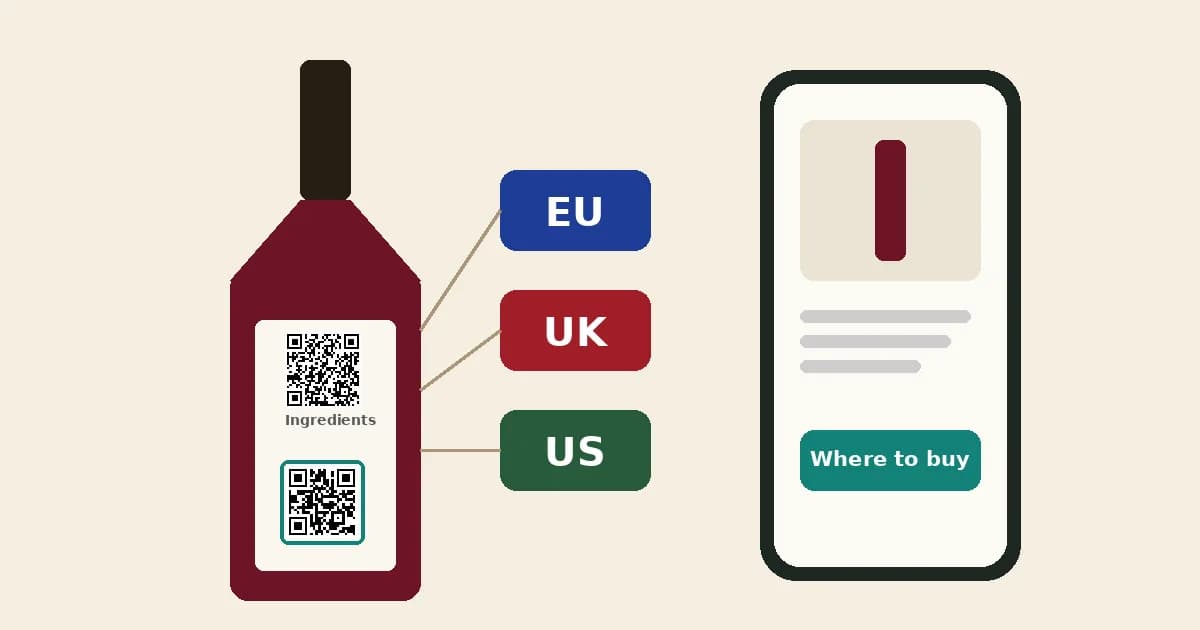
A small winery rarely prints a different back label for every country, yet the same bottle might go to Germany, London and California. The QR code rules are not the same in each place: the EU is strict, Great Britain doesn't require an e-label at all, Northern Ireland follows the EU, and the US is still waiting on proposals that haven't become law. This guide sets out where each market stands as of October 2026 and how to plan one label that copes with all of them.
Plain-language guidance, not legal advice. Labelling rules change, so check the current position for your own wines and markets with your compliance adviser or importer.
What does the EU require on a wine label?
Since 8 December 2023, wine produced for sale in the EU has to give buyers its list of ingredients and a nutrition declaration. The rules come from Regulation (EU) 2021/2117. Two things must stay printed on the bottle: the energy value, and any allergens such as "contains sulphites". The full ingredient list and nutrition table can move behind a QR code, an e-label, as long as the code sits in the same field of vision as the other compulsory information.
The page behind that code has strict limits. It must open the information straight away, it must not show sales or marketing content, and it must not collect or track user data. The code also has to be identified on the label with a word such as "Ingredients"; a bare QR code or a lone "i" is not enough. Our EU e-label guide covers each point in detail.
What changed for EU wine labels in 2026?
The EU's "wine package", Regulation (EU) 2026/471, entered into force on 18 March 2026. For labels, the main change is that the Commission can now set a common, language-free pictogram to identify the e-label code instead of words, and set rules on how the information behind the code is laid out. At the time of writing that pictogram hasn't been published, so keep printing the word "Ingredients" next to the code.
If you make batches only for markets outside the EU, ask your adviser which EU rules still apply to them before you design a separate label.
Does a wine sold in the UK need a QR code?
In Great Britain (England, Scotland and Wales), no. The UK government says it has not made ingredient or nutrition labelling mandatory for wine, though a QR code for that information is allowed. What GB does require includes an allergen statement with the word "contains" when sulphur dioxide is above 10 mg per litre, or when egg or milk fining agents are detectable above the set limits. Since 1 January 2024, wine imported into England must also show the name and address of a UK business that takes responsibility for marketing it.
Northern Ireland is different. Under the Windsor Framework, wine placed on the market there must follow the EU rules, so it needs the ingredients and nutrition information on the label or through an e-label. Goods moved from Great Britain under the Northern Ireland Retail Movement Scheme are treated differently and carry a "Not for EU" marking. If your UK importer supplies Northern Ireland, ask which route they use.
What about wine exported to the US?
Today the US doesn't require an ingredient list or nutrition panel on wine. That may change. On 17 January 2025 the Alcohol and Tobacco Tax and Trade Bureau (TTB), which regulates US alcohol labels, published two proposals. Notice No. 237 would require an "Alcohol Facts" statement covering serving size, alcohol content, calories, carbohydrate, fat and protein per serving. Notice No. 238 would require labels to declare major food allergens used in production, including milk, eggs and fish, which covers some fining agents.
Comments on both closed on 15 August 2025. As of October 2026 neither has become a final rule, and both propose a five-year compliance period that only starts once a final rule is published. There's no deadline yet, but it's sensible to keep allergen and nutrition records for each wine. Any change to a US label, including adding a QR code, should also be checked against your label approval (COLA) with your importer.
Can one back label work for every market?
Usually, yes, if you design for the strictest market and keep the extra parts harmless elsewhere. A practical approach:
- Start from the EU version: compulsory particulars, the energy value, the allergen line and an "Ingredients" QR code beside them.
- Keep the ingredients page neutral everywhere. A plain, untracked page meets the EU rule and causes no problems in GB or the US, where it simply counts as extra information.
- Add a UK business name and address, or a strip label applied by your importer, for bottles going to Great Britain.
- For the US, work with your importer on the mandatory US items and on whether the EU code and wording need any changes for label approval.
- Put tasting notes, the winery story and a reorder link on a second, separate code, never on the ingredients code.
The EU also expects the e-label in a language buyers in each market understand, which one printed code can handle by opening the right language version.
How should the marketing code work across countries?
The second code is where export markets can differ the most, because selling alcohol online is regulated country by country and, in the US, state by state. A few points to plan for:
- Point the reorder button at a page that knows where you can sell. If your own shop only ships within the EU, a US drinker should land on a "where to buy" page or your importer's list of stockists, not a checkout that will refuse them.
- Check the page copy for each market. Some countries restrict alcohol marketing, France's Loi Évin being the best-known example.
- Keep the call to action honest. "Scan for tasting notes and where to buy" is a promise the page can keep in every market.
Scan counts per code show which bottles get picked up. If you want to know which markets they come from, give each export market its own marketing code, so the US batch and the EU batch report separately. Add UTM tags to the reorder link (for example ?utm_source=bottle&utm_medium=qr) so your shop's analytics show which orders started with a scan.
A quick checklist before you print
- EU and Northern Ireland: energy value and allergens printed, "Ingredients" code in the same field of vision, a neutral page with no marketing or tracking.
- Great Britain: allergen statement, UK business name and address for imports into England, e-label optional.
- US: current TTB label requirements met, label approval checked with your importer, records ready in case the Alcohol Facts and allergen proposals become final.
- All markets: two clearly separate codes, each at least 2 × 2 cm, tested on the real label stock with more than one phone.
FAQs
Do I need an e-label for wine sold only in Great Britain?
Not at the time of writing. Great Britain hasn't made ingredient or nutrition labelling mandatory for wine. You can still add an ingredients code if the same bottles also go to the EU or Northern Ireland.
Will the US make QR codes mandatory on wine labels?
The TTB proposals are about what information wine labels must disclose, not about QR codes as such. Neither proposal is final, so check the TTB's rulemaking page before you plan a US label change.
Can the marketing page be in more than one language?
Yes. On Tapline's Scale plan, one page can be shown in more than one language, with a language switcher for the shopper. See the pricing page for what each plan includes.
Which Tapline plan includes the reorder button?
The Growth plan, at $29/month, includes the reorder button and scan analytics for up to 10 pages. The Free plan gives you one page and its QR code without the reorder button.
Where does Tapline fit?
Tapline gives each wine its own marketing page and QR code: a story page with tasting notes, a reorder button to your own shop or stockist list, and scan counts per code, editable after printing. The marketing page is never the legal e-label. Tapline can also host a separate, neutral e-label page that you fill in yourself, and you are responsible for its accuracy. Tapline is built by Esipick, which has been building software for brands since 2013.
Related: what happens after the scan.
Related: EU e-label rules for wine.
Related: two QR codes on one label.
Related: turning bottle scans into reorders.
Related: what QR scan data can tell you.
Related: QR codes on spirits labels.
Related: pricing.