Spirits
QR Codes on Spirits Labels: Rules, Ideas and Reorders
Do spirits need a QR code in the EU? Where the rules stand, the industry's voluntary pledge, and how distilleries use a marketing code for serves and reorders.
By Ali Murtaza ·
Wineries had a hard deadline: since 8 December 2023, wine sold in the EU must give buyers its ingredients and nutrition information, on the label or through a QR code. Spirits never got that deadline, yet more and more bottles of gin, whisky and rum now carry a QR code anyway. This guide explains where the rules for spirits actually stand, what the industry has committed to, and how a small distillery can use a QR code on the label to sell the next bottle.
Plain-language guidance, not legal advice. Labelling rules change, so check the current position for your own products and markets with your compliance adviser.
Do spirits need a QR code on the label in the EU?
Not by law, at the time of writing. EU food labelling rules exempt drinks above 1.2% alcohol from the mandatory ingredient list and nutrition declaration. The 2023 rules that made wine list them apply to wine and aromatised wine products, not to spirit drinks. Spirit-drink labelling rules were adjusted again in 2026 by Regulation (EU) 2026/471, so your adviser should confirm what that change means for your labels.
The direction of travel is clear, though. In its 2021 Europe's Beating Cancer Plan, the European Commission said it would propose mandatory ingredient and nutrition labelling for all alcoholic drinks. If that happens, distilleries that already have a clean ingredients page and space for a code on the label will have far less to change.
What has the spirits industry agreed to do?
In June 2019, spiritsEUROPE, the trade body for Europe's spirits producers, signed a Memorandum of Understanding with a voluntary three-part commitment:
- Energy information (kJ and kcal, per 100 ml and per portion) on the back label.
- The full ingredient list and nutrition information available by scanning a QR code.
- Detailed product information online.
Large producers make up most of the reported progress, and spiritsEUROPE publishes a yearly report on how far the roll-out has got. Smaller distilleries can follow the same approach without signing anything. For a buyer or importer, a bottle that shows energy on the label and ingredients behind a code already looks like a responsible, export-ready product.
Should the ingredients page stay free of marketing?
For wine, yes: the EU e-label page can't sell, can't link to a shop and can't track who scans it. Spirits aren't bound by that wine rule today, but it's sensible to follow it anyway. Shoppers who have seen wine e-labels expect a plain information page, importers who handle wine know the rule, and if mandatory labelling arrives for spirits, a similar rule may well come with it. Keeping the ingredients page neutral now means you won't have to rebuild it later.
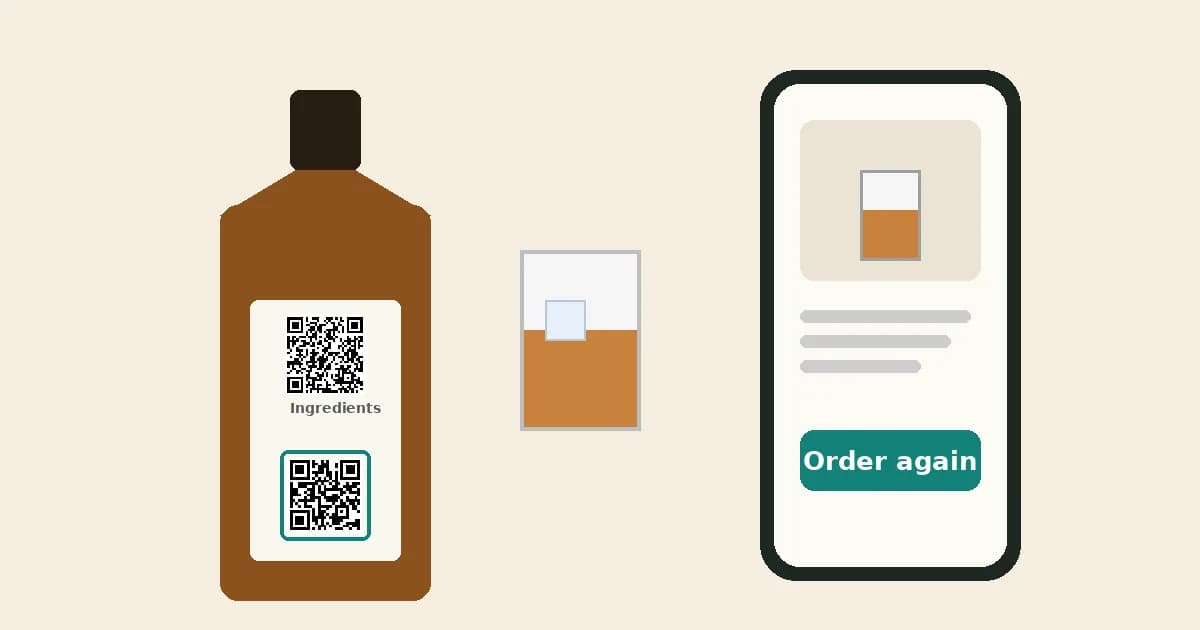
So, as with wine, the practical answer is two codes: a plain one marked "Ingredients" next to the legal text, and a separate marketing code for everything else. Our guide to two QR codes on a wine label covers placement, size and labelling for both, and it applies to a spirits bottle in the same way.
What can a marketing QR code on a spirits bottle do?
A spirits bottle stays open on a shelf or a back bar for weeks or months, so a marketing code gets more chances to be scanned than almost any other product. Useful things to put behind it:
- Serves and cocktails. Two or three recipes that use your spirit, with a signature serve first. This is the most common reason someone scans a bottle of gin or rum.
- Provenance. Where the grain, botanicals or cane come from, how it's distilled, and the people behind it, in a few short paragraphs.
- Batch or cask details. For small-batch and single-cask releases, the batch number, cask type, bottling date and outturn are exactly what collectors want to read.
- A reorder button. A direct link to that exact bottle in your own shop, so a drinker who finishes it can buy another without searching.
- Distillery visits and events. A link to your tour booking or tasting page for drinkers near the distillery.
On Tapline today, the story page, the reorder button, scan counts, email signups stored inside Tapline and pages in several languages are live. Shopify sync is coming soon. You can also link to your own booking or newsletter page from the story page.
How should a distillery handle limited releases?
Use a dynamic code, which prints a short link that you can point somewhere new later. For a core range, one code per product is enough: the page can be updated when the recipe, price or awards change, and the printed code stays the same.
For limited releases, give each batch or cask its own code and its own page. Collectors scan to check details, and a page per release lets you show the right batch number and tasting notes. When the release sells out, update the page to say so and point the button at the next release, rather than leaving a dead link on bottles that will sit in cabinets for years.
What should the label say next to the marketing code?
An unlabelled code rarely gets scanned, and on a spirits bottle it can be mistaken for the ingredients code. Give it a short line that says what happens next:
- "Scan for our signature serve"
- "Scan for cocktails & to order another bottle"
- "Scan for the story of batch 07"
Keep words like "Ingredients" or "Nutrition" for the plain code only. Print the marketing code at least 2 × 2 cm with a clear margin, and test it on the real label stock, because foil, embossing and dark or textured paper can stop phones reading it.
Rules to keep in mind for alcohol marketing pages
- Age checks. Your shop should handle age verification and the places you can legally ship to, as it does for any visitor.
- Market rules. Some countries limit what alcohol marketing can say. France's Loi Évin is the best-known example. Check the page content for each market you sell into.
- Responsible drinking. A short responsible-drinking line or link on the page is good practice and is expected in many markets.
- Honest claims. Only promise a reorder or a cocktail recipe on the label if the page really has one.
How do I know if the code is working?
Tapline shows scans per code over time, without storing personal data about who scanned. That tells you which bottles get picked up, which is useful when you're deciding which channels are working. Orders come from your own shop's analytics: add UTM tags to the reorder link (for example ?utm_source=bottle&utm_medium=qr) so you can see which sales started with a scan. Our post on what QR scan data can and can't tell a winery explains how to read these numbers, and the same thinking applies to spirits.
FAQs
Is a QR code for ingredients mandatory on spirits in the EU?
Not under current EU law. Drinks above 1.2% alcohol are exempt from the mandatory ingredient list and nutrition declaration, and the 2023 rules cover wine and aromatised wine products. Many spirits producers provide the information voluntarily under the spiritsEUROPE commitment. Check the latest position before you reprint labels.
Can one QR code do both jobs on a spirits bottle?
You can technically, because there's no spirits-specific rule against it today. We still recommend two codes, so the ingredients page stays neutral and you won't need to change your labels if rules like the wine ones are extended to spirits.
Does a reorder button work with any online shop?
Yes. The reorder button is a plain link to your own shop, so it works with any store. Shopify sync, which would keep price and stock up to date automatically, is coming soon.
Which Tapline plan includes the reorder button?
The Growth plan, at $29/month, includes the reorder button and scan analytics for up to 10 pages. The Free plan gives you one page and its QR code without the reorder button. See the pricing page for details.
Where does Tapline fit?
Tapline gives each spirit its own marketing page and QR code: a story page with serves and provenance, a reorder button to your own shop, and scan counts per code. The marketing page is never the ingredients page; Tapline's hosted e-label page is for wine today, so host your spirits ingredients page yourself. Tapline is built by Esipick, which has been building software for brands since 2013.
Related: what happens after the scan.
Related: QR codes for spirits and wine.
Related: two QR codes on one label.
Related: EU e-label rules for wine.
Related: turning bottle scans into reorders.
Related: what QR scan data can tell you.
Related: pricing.