
Wine
Wine E-Labels and New Vintages: When You Need a New One
When a new wine vintage needs its own EU e-label, why the energy value usually decides it, and how to handle old pages, non-vintage wines and lot changes.
By Ali Murtaza ·
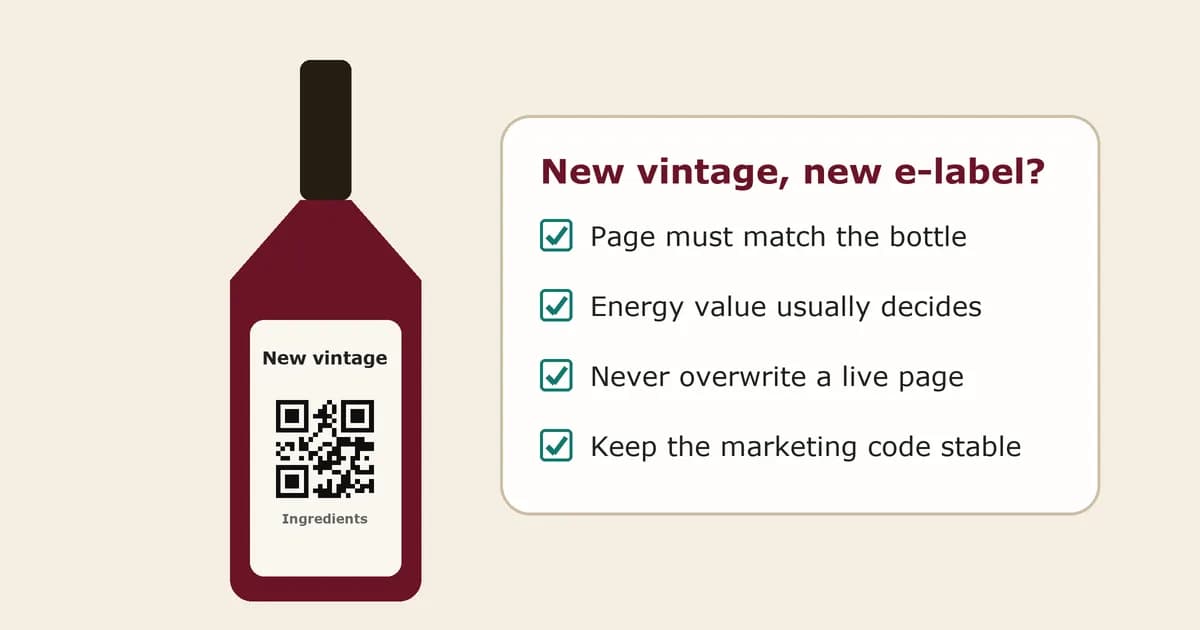
Every harvest brings the same question for wineries that moved their ingredients and nutrition information behind a QR code: can next year's bottles use the same e-label page, or does each vintage need its own? The answer depends on what changed in the wine, and getting it wrong in either direction causes trouble. Reuse a page when the numbers have moved and the e-label no longer matches the bottle. Overwrite a page when last year's wine is still on shelves and those bottles now point at the wrong information. This guide covers when a new e-label is needed, why the energy value usually decides it, how to handle non-vintage wines and mid-vintage changes, and how to keep old pages working.
Plain-language guidance, not legal advice. Check the European Commission's Q&A on wine labelling and your national authority's guidance for your own wines.
The rule that drives everything: the page must match the bottle
Since 8 December 2023, wine produced for the EU market has to give buyers a list of ingredients and a nutrition declaration. Both can move to an electronic label reached by a QR code, as long as the energy value and any allergens stay printed on the bottle and the e-label page carries no sales or marketing content and does not collect or track user data. Wine produced before that date can still be sold until stocks run out.
What the rules do not do is tie an e-label to a calendar year. The e-label is the label for that wine, so it has to describe what is actually in the bottle. If two vintages share an identical ingredients list and nutrition declaration, one page can serve both. If anything on the page differs between them, the bottles need pages that say different things, which in practice means a separate page and usually a separate code.
Why the energy value usually decides it
The energy value is the line most likely to change between vintages, and it is printed on the bottle as well as shown on the e-label. Energy in wine comes mainly from alcohol and residual sugar. Alcohol carries about 7 kcal per gram and sugar about 4 kcal per gram, and 1% alcohol by volume is about 0.79 g of alcohol per 100 ml. That means every 1% of alcohol adds roughly 5.5 kcal per 100 ml, and every gram of residual sugar per litre adds about 0.4 kcal per 100 ml.
So a vintage that comes in half a percent riper shifts the energy value by around 3 kcal per 100 ml, before any change in sugar. Whether the declared figure changes depends on how you calculate and round it, but a warmer year with higher alcohol will often move it. When it does, the printed "E" figure on the label changes, the nutrition table on the e-label changes, and the old page no longer matches the new bottles. Our guide to calculating wine calories for an e-label walks through the arithmetic.
Other changes that mean a new e-label
- A different additive or processing aid that has to be listed, for example a new acidity regulator, preservative or stabiliser.
- A change in allergens, such as fining with egg or milk proteins in one vintage and not the next. The allergen statement on the bottle changes too.
- A different sweetening, such as tirage and expedition liqueur in sparkling wine, that changes the ingredients list or sugar content.
- Rounded nutrition values that move, such as carbohydrates or sugars, even if the energy value stays the same.
- A move from wine produced before 8 December 2023 to wine produced after it, if you previously relied on the transition rule and had no e-label at all.
Changes that do not touch the page's content, such as a new label design, a different closure or a new tasting note, do not by themselves need a new e-label. Tasting notes and stories belong on your marketing page anyway, never on the e-label.
Never overwrite a page that bottles still point to
The tempting shortcut is to keep one page per wine and edit it each year. The problem is that bottles from earlier vintages stay in shops, restaurants and cellars long after the new one is released. If you overwrite the page, someone scanning a 2023 bottle sees the 2024 numbers, and the e-label no longer describes the wine in their hand. The same applies to dynamic QR codes: being able to change where a code points after printing is useful for marketing pages, but the legal page for a bottle on the market should stay as it was when the bottle was released.
A safer pattern is one e-label page per wine per vintage, each with a stable address that never changes. When a new vintage needs different information, create a new page and a new code for it and leave the old page online. Many wineries keep old pages live for as long as bottles could reasonably still be sold or opened, which for age-worthy wines can mean many years. Before you choose an e-label tool, ask what happens to those pages if you stop paying; our checklist for choosing a wine e-label generator covers that question.
Non-vintage wines and mid-vintage changes
Non-vintage wines, multi-vintage blends and many sparkling wines raise the same question in a different form. There is no vintage year to hang the page on, but the composition can still change between bottlings or disgorgements, especially when the dosage changes. The practical answer is to tie each e-label page to a bottling, lot or cuvée version rather than a year, and to issue a new page whenever the ingredients list or nutrition values change.
Mid-vintage changes work the same way. If part of a vintage is bottled with one treatment and part with another, and the ingredients list differs, those are two different labels in practice, so they need two e-label pages and codes. Keep a simple record of which lot numbers carry which code, so you can answer an inspector, an importer or a customer quickly.
Keep the marketing code stable
The second QR code on the back label, the one for your story, tasting notes and reorders, works the other way round. There you want the printed code to stay the same across vintages and reprints, and the page behind it to be updated each year with the new vintage, awards and stockists. That keeps your label artwork simpler and means older bottles still land on a page that is current and can sell the next bottle. Our guide to two QR codes on one wine label shows how to lay the codes out so nobody scans the wrong one.
A vintage changeover checklist
- Recalculate the energy value and nutrition declaration from the new vintage's alcohol and residual sugar, and compare the rounded figures with last year's.
- Review the ingredients list against the new vintage's winemaking records, including fining agents and any additives.
- Check the allergen statement on the bottle against the new ingredients list.
- If anything on the e-label changes, create a new page with its own stable address and generate a new code for it. Do not edit the old page.
- Update the printed energy value and allergen line on the new label artwork.
- Keep the old vintage's page online and unchanged, and note how long you plan to keep it.
- Update the marketing page behind your second code with the new vintage, and keep that code the same.
- Record which code goes with which vintage and lot, and scan a press proof of each code before the run.
FAQs
Do I need a new e-label for every vintage?
Not automatically. You need a new one when anything on the e-label differs, such as the ingredients, allergens or nutrition values. In practice the energy value often changes between vintages because alcohol and sugar levels change, so many wineries end up with one page per vintage.
Can I just update my existing e-label page for the new vintage?
Only if no bottles of the earlier vintage remain on sale or in circulation, which is rarely the case. Otherwise older bottles would point to information that does not match them. Create a new page and keep the old one unchanged.
Can one QR code cover several vintages?
Yes, if the e-label content is identical for all of them. If any value differs, each version needs its own page, and usually its own printed code, so every bottle points to information that matches it.
How long should I keep old e-label pages online?
We have not seen a fixed period in the EU wine rules. Many wineries keep pages live for as long as bottles could still be sold or opened, which can be years for wines built to age. Check your national authority's guidance and your provider's terms.
Does the marketing QR code need to change each vintage?
No. The marketing code is not the legal e-label, so you can keep the same printed code and update the page behind it each year.
Where does Tapline fit?
Tapline is not your compliance check or your winemaking record. It powers the second code on the back label: a story page for each wine, a reorder button that sends buyers to your shop or stockist list, and scan counts per code, all editable after the labels are printed, so the printed code can stay the same from one vintage to the next. On the Scale plan the page can be shown in several languages for export markets. Shopify sync is coming soon. The marketing page is never the legal e-label. Tapline can also host a separate, neutral e-label page for wine that you fill in yourself, and you are responsible for its accuracy. Tapline is built by Esipick, which has been building software for brands since 2013.
Related: what happens after the scan.
Related: how to calculate wine calories for an e-label.
Related: how to write a wine ingredients list.
Related: wine allergen labelling.
Related: static vs dynamic QR codes on wine labels.
Related: two QR codes on one label.
Related: how to choose a wine e-label generator.
Related: EU e-label rules for wine.
Related: pricing.