
Wine
Sparkling Wine E-Labels: Dosage, Liqueurs and Energy
How EU e-labels for sparkling wine treat tirage and expedition liqueur, dosage, sweetness and energy, and what still has to be printed on the bottle.
By Ali Murtaza ·
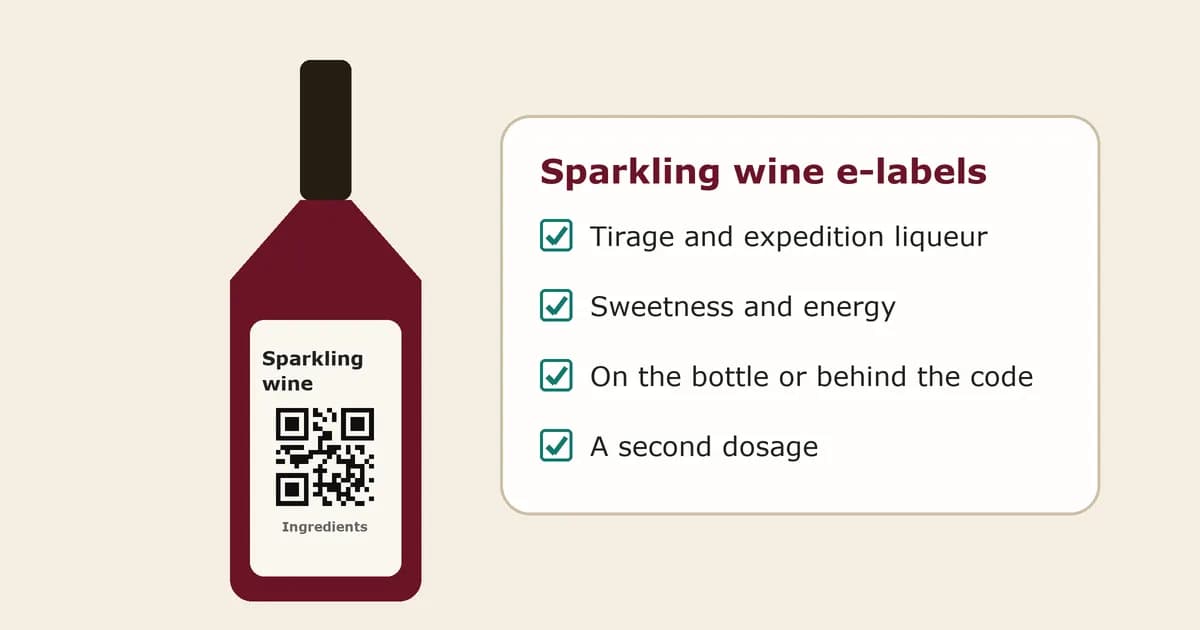
Champagne, Cava, Prosecco, Crémant and other sparkling wines add a tirage liqueur to start the second fermentation, then usually an expedition liqueur, the dosage. That changes the ingredients list, the sweetness word on the bottle and often the energy value.
Plain-language guidance, not legal advice. Check the Commission's Q&A on wine labelling and your national authority, plus any protected-designation specification.
Which rules apply
Regulation (EU) 2021/2117 amended Regulation (EU) No 1308/2013 so wine produced for the EU needs a nutrition declaration and an ingredients list. Article 119 lets you give both by electronic means, such as a QR code. Energy stays on the bottle. Allergens stay on the bottle, after "contains". The e-label page has no sales or marketing material and must not collect or track user data.
Article 48a of Delegated Regulation (EU) 2019/33, added by Delegated Regulation (EU) 2023/1606, names tirage liqueur, expedition liqueur and packaging gases. Annex II to Delegated Regulation (EU) 2019/934 lists what the liqueurs may contain. Article 47 and Part A of Annex III make a sweetness term compulsory for sparkling wine, aerated sparkling wine, quality sparkling wine and quality aromatic sparkling wine. Commission notice C/2023/1190 is the Q&A.
A second fermentation counts as produced only after it has happened and the wine has the strength and pressure for its category. Preparing the cuvée before 8 December 2023 is not enough to keep the old labels. Wine produced before that date can be sold until stocks run out.
Tirage liqueur and the dosage
Article 48a(7) lets you write "tirage liqueur" and "expedition liqueur", alone or with constituents in brackets. Recital 16 of Regulation 2023/1606 says listing those constituents loose may mislead buyers. Annex II says adding either liqueur is neither enrichment nor sweetening.
Expedition liqueur may contain only sucrose, grape must, grape must in fermentation, concentrated grape must, rectified concentrated grape must, wine, or a mixture, plus wine distillate if used. Sucrose may be written "sugar". That list also covers quality sparkling wine and PDO sparkling wine. Tirage liqueur has its own closed list, different for sparkling wine, quality sparkling wine and PDO wines. Copy the Annex II list for your category.
Yeast is not in those lists. Table 2 classes yeasts for wine production as a processing aid, including for the second fermentation, and the Q&A says they need not be listed.
Tirage sugar is added to ferment, so it raises alcohol rather than residual sugar. Annex II caps the rise in total alcoholic strength from tirage liqueur at 1.5% vol. Expedition liqueur sets finished sweetness and must not raise actual strength by more than 0.5% vol.
Brut nature, pas dosé, dosage zéro and the matching terms need under 3 g/l and no sugar added after the secondary fermentation. Do not list an expedition liqueur that added sugar. Tirage liqueur can still appear. Annex II prohibits expedition liqueur in quality aromatic sparkling wine.
Grapes come first. Items under 2% of the finished wine may follow in any order. These rows show the format only.
| Wine | Example list |
|---|---|
| Brut nature | Ingredients: grapes, tirage liqueur (wine, sugar), preservative: sulphites. |
| Brut | Ingredients: grapes, tirage liqueur (wine, sugar), expedition liqueur (sugar, wine), preservative: sulphites. |
Sweetness and energy
Article 47 puts one Annex III term on the label. If two terms fit, choose one. It also says sugar may not differ by more than 3 g/l from what appears on the label. The Q&A does not show how that 3 g/l is checked against a word such as "brut", so confirm it locally.
| Term | Sugar content |
|---|---|
| Brut nature, pas dosé, dosage zéro | Under 3 g/l, and no sugar added after the secondary fermentation |
| Extra brut | 0 to 6 g/l |
| Brut | Under 12 g/l |
| Extra dry | 12 to 17 g/l |
| Sec, dry | 17 to 32 g/l |
| Demi-sec | 32 to 50 g/l |
| Doux | Over 50 g/l |
At 4 g/l, extra brut and brut both fit, so you pick one. At 9 g/l only brut fits.
The word does not replace the sugars line. Nutrition is per 100 ml. Divide g/l by 10, so 9 g/l is 0.9 g per 100 ml. Annex XIV of Regulation (EU) No 1169/2011 sets sugar at 17 kJ and 4 kcal per gram, so each 1 g/l adds 1.7 kJ and 0.4 kcal per 100 ml. Kilojoules come first.
At 12% vol the alcohol alone is about 275 kJ and 66 kcal per 100 ml. Moving dosage from 4 g/l to 9 g/l adds about 8.5 kJ and 2 kcal per 100 ml before glycerol, acids and rounding. Our calorie guide finishes that sum on the wine as sold. Expedition liqueur may also raise actual strength by up to 0.5% vol. Use the Commission's tolerance guidance with your lab. The wine rules set no sparkling-only percentage.
On the bottle or behind the code
The code may hold the full nutrition declaration and the ingredients list. In the same field of vision the bottle still needs the category, unless a protected designation or indication lets you omit it, the sweetness term, strength, provenance, net content, the bottler or where required the producer or vendor, and energy per 100 ml. The symbol "E" is allowed. The code needs a heading with "ingredients". Allergens use "contains" and need not share that field of vision. Compulsory characters are at least 1.2 mm.
Aerated sparkling wine and aerated semi-sparkling wine add "obtained by adding carbon dioxide" or "obtained by adding carbon anhydride", in the same type and size, unless the language already says that. That is Article 48 of Regulation 2019/33.
The legal e-label page has no tracking or marketing. Consent does not allow tracking. Tasting notes, a reorder link and scan counts go on a second code.
A second dosage
Extra brut and brut from one cuvée need different artwork, because the sweetness term is printed. Change the ingredients list if the liqueurs or their brackets differ, and the nutrition declaration if rounded energy or sugars no longer fit the earlier bottles. A dosage you changed on purpose needs its own page and code. Leave the earlier page as released, and record which lot uses which code. The marketing code can stay the same across disgorgements.
Gases and other additives
Do not list fermentation carbon dioxide as a packaging gas. Annex II allows it only from fermentation of the cuvée, in bottle or a closed tank. Transfer by counter-pressure may use carbon dioxide only under supervision, without raising that pressure.
Argon (E 938), nitrogen (E 941) and carbon dioxide (E 290) are in Table 2. As a packaging gas, name the category and the substance or E number, or use "Bottled in a protective atmosphere" or "Bottling may happen in a protective atmosphere" instead. That phrase replaces the gas names and sits with the ingredients list. Do not list alternative gases.
If a step is not in Table 2 or Annex II, ask your authority before listing it.
FAQs
Does tirage sugar go on the sugars line?
Only sugar left in the wine as sold. Grams per litre set the sweetness term. Divide by 10 for sugars per 100 ml.
Can brut nature list tirage liqueur?
Yes, if you used it. You still need under 3 g/l and no sugar added after the secondary fermentation.
Does each dosage need its own e-label?
Yes when the sweetness term, ingredients, or rounded energy or sugars differ. Leave the old page unchanged.
Can the QR code replace "brut"?
No. Article 47 keeps the Annex III term on the label. The code carries ingredients and the full nutrition table.
Where does Tapline fit?
Tapline is not your compliance check. It powers the second code: a story page, a reorder button to your shop or stockist list, and scan counts per code. On the Scale plan the page can be shown in several languages. The marketing page is never the legal e-label. The legal e-label page has no tracking or marketing. Tapline can also host a separate, neutral e-label page for wine that you fill in yourself, and you are responsible for its accuracy. Tapline is built by Esipick, which has been building software for brands since 2013.
Related: what happens after the scan.
Related: how to calculate wine calories for an e-label.
Related: how to write a wine ingredients list.
Related: when a new vintage needs a new e-label.
Related: two QR codes on one label.