
Wine
Wine Shelf Talkers and Neck Tags with QR Codes
How to use QR codes on wine shelf talkers and neck tags: what to put behind the code, print specs, call-to-action wording, and keeping the e-label separate.
By Ali Murtaza ·
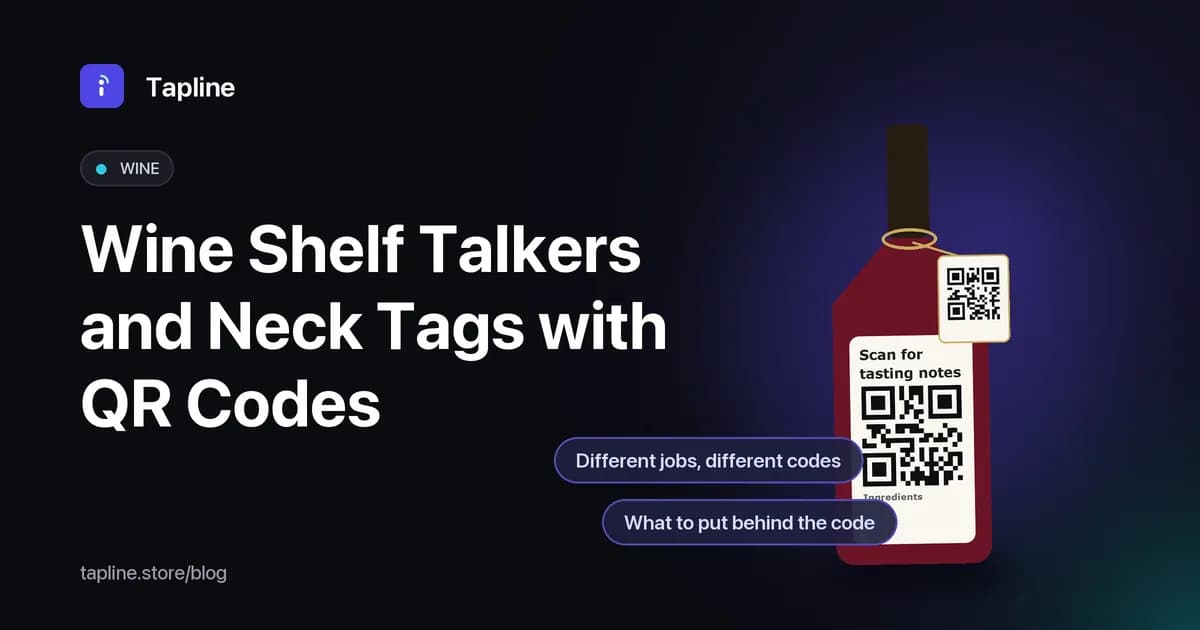
Most wine is chosen in under a minute, standing in an aisle with a phone already in one hand. A shelf talker or a neck tag with a QR code gives that buyer something the back label cannot: a short story, a tasting note, a food pairing and a way to buy the next bottle. Done badly, it is one more square nobody scans. This guide covers what to put behind the code, how to word it, how to keep it apart from the legal e-label, and how to tell which placement actually gets used.
Shelf talkers, neck tags and the back label are different jobs
A shelf talker sits on the shelf edge or in a wobbler in front of the bottles. It belongs to the retailer's display, can be swapped every season and is often printed in small runs. A neck tag (or neck collar) hangs on the bottle itself and travels home with it. The back label is printed once per run and carries the compulsory information.
That difference decides what each code should do:
- Shelf talker: help someone choose now. Tasting notes, pairings, a short video, the award or review the wine actually received, and the price band it competes in.
- Neck tag: help someone enjoy the bottle at home and buy it again. Serving temperature, pairings, the winery story and a reorder link.
- Back label: the legal e-label code for ingredients and nutrition, plus an optional second code for the marketing page. Our guide to two QR codes on a wine label covers that layout.
Keep the legal e-label on the bottle
In the EU, wine can move its ingredients list and full nutrition declaration behind a QR code on the label, under Article 119 of Regulation (EU) No 1308/2013 as amended by Regulation (EU) 2021/2117. That page must not carry sales or marketing content and must not collect or track user data. The energy value and allergens stay printed on the bottle.
A shelf talker is not part of the bottle, so it cannot replace the e-label code. A neck tag is attached to the bottle, but it can be removed and is easy to lose, so treat it as the place for your marketing code, not the legal one. Keep the e-label code on the label itself, with its "ingredients" heading, and let the tag and the shelf talker point to the page you are free to design and measure.
Food information law also counts a collar or tag accompanying the food as part of its labelling (Article 2(2)(j) of Regulation (EU) No 1169/2011). In practice that means anything you say on a neck tag, such as a sweetness description or a medal, must be accurate and must not mislead, just as it would on the label. This is general information, not legal advice.
What to put behind the code
A buyer in a shop has a few seconds and often weak signal. The page should load fast and answer their first question before they scroll. A good order:
- One line on what the wine tastes like, in plain words.
- Two or three food pairings.
- Serving temperature and whether it needs decanting.
- A short winery story or a 15 to 30 second clip, with captions because most phones are on mute in a shop.
- Real reviews or awards, named and dated, only if the wine actually received them.
- A clear next step: where to buy it again, the winery shop or a stockist list.
Leave out long histories, newsletter pop-ups and age gates that block the page before the buyer sees anything useful. If your market requires an age confirmation for alcohol marketing, keep it short.
Write a call to action people will act on
"Scan me" tells nobody why they should. A short reason works better, in the language of the market, placed directly above or beside the code. Examples that fit a shelf talker or a neck tag:
- "What to eat with this"
- "Tasting notes in 20 seconds"
- "Meet the winemaker"
- "Buy this again" (on the neck tag, where the bottle is already in the buyer's home)
Check what alcohol promotion is allowed to say in each market. Some countries restrict it closely; France's Loi Évin, for example, limits alcohol advertising mainly to factual information such as origin, composition and production method. A shelf talker in a French shop should be written with that in mind, and your importer or distributor will usually know the local rules.
Print specs for small formats
Shelf talkers and neck tags are small, often curved or hanging at an angle, and read under shop lighting. A few rules help:
- Keep the code at least 2 cm wide for a shelf talker read at arm's length, larger if it sits on a low shelf.
- Leave a quiet zone of clear space around the code, about four modules wide.
- Print dark on light. Avoid gold foil, metallic inks or a code across a fold.
- Use a short link so the code has fewer modules and scans faster.
- Test the printed proof on several phones, in shop-like light, before the full run.
Our guide to wine label QR code size and print specs goes into module size, contrast and testing in more detail.
Give each placement its own code
If the shelf talker, the neck tag and the back label all use the same code, you cannot tell which one people actually scan. Give each placement its own code pointing to the same wine page, and compare the scan counts per code after a few weeks. The same works for retailers: a separate code for each chain or for each display campaign shows which one drives interest.
Use a dynamic code, one whose destination you can change after printing. Shelf talkers often outlive a vintage, and neck tags get reused across runs. When the vintage changes or a stockist drops the wine, you update the page instead of reprinting. Our guide to static and dynamic QR codes explains the difference.
A simple checklist before you print
- The legal e-label code stays on the bottle's label with its "ingredients" heading.
- The shelf talker and neck tag codes go to the marketing page, never to the e-label page.
- Each placement has its own code so you can compare scans.
- The call to action says what the buyer gets, in the market's language.
- Every claim, award or review on the tag is accurate and checked.
- The page loads fast on mobile data and has a clear way to buy again.
- The printed proof scans on several phones in shop lighting.
How Tapline fits
Tapline is not your legal statement or your compliance check. It powers the marketing codes on your shelf talkers, neck tags and back label: a story page for each wine, a reorder button on the Growth plan and above that sends buyers to your shop or stockist list, and scan counts per code, so you can see which placement gets used. You can update the page without reprinting. On the Scale plan the page can be shown in several languages for export markets. The marketing page is never the legal e-label. Tapline can also host a separate, neutral e-label page for wine that you fill in yourself, and you are responsible for its accuracy.
See how it works for wineries on the wine page: /wine
Related guides
- Two QR codes on a wine label
- Wine bottle QR codes that turn into reorders
- Wine tasting room QR codes
- Wine label QR code size and print specs
- Wine QR code scan analytics
- Static vs dynamic QR codes on wine labels
FAQ
Can a shelf talker QR code replace the e-label on the bottle?
No. The e-label code for the ingredients list and nutrition declaration belongs on the bottle's label. A shelf talker is a display item that stays in the shop, so it can only carry a marketing code.
Can the code on a neck tag lead to marketing content?
Yes, as long as it is not the legal e-label code. The no-marketing and no-tracking conditions apply to the e-label page. A separate marketing page can carry your story, pairings and a reorder link, but claims on the tag and the page must still be accurate.
How big should a QR code on a shelf talker be?
Around 2 cm wide is a sensible minimum at arm's length, with clear space around it. Go larger for low shelves or wobblers, and always test a printed proof in the shop's light.
Should the shelf talker and neck tag use the same QR code?
Better not. Separate codes pointing to the same page let you compare scan counts per code and see which placement buyers actually use.
What if the wine changes vintage after the shelf talkers are printed?
Use a dynamic code. You update the page behind it for the new vintage instead of reprinting the shelf talkers or neck tags.