
Cosmetics
QR Codes on Cosmetics Packaging: What They Can't Replace
What a QR code on a skincare or cosmetics label can do, what it can't replace under MoCRA and EU rules, and what the scan should open to drive reorders.
By Ali Murtaza ·
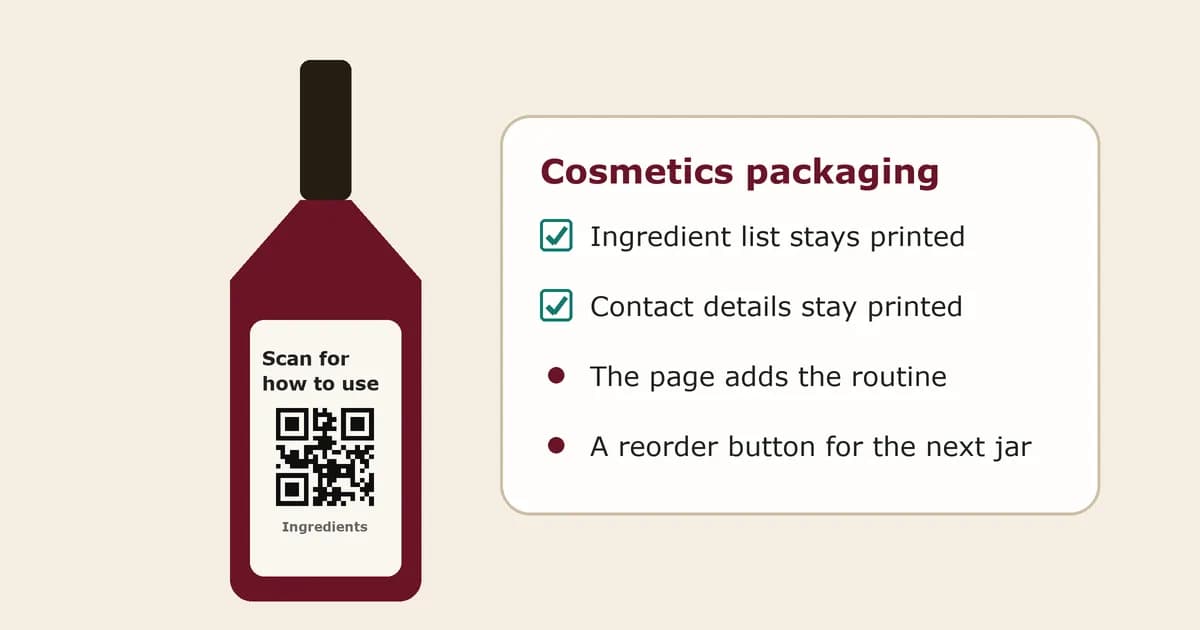
A QR code on a jar of moisturiser can do a lot: show the routine, explain the ingredients in plain words, and put a reorder button in front of someone the week they run out. What it can't do is replace the words the law says must be printed on the pack. Brands that mix those two jobs up end up with either a crowded label or a compliance problem.
This guide covers what has to stay printed in the US and the EU, what a QR page can add, and how to set one up so it earns repeat orders. It's general information, not legal advice; check your own labels with a regulatory adviser.
Can a QR code replace the ingredient list on cosmetics?
No. In the US, the ingredient declaration has to appear on the outer container of a cosmetic sold to consumers (21 CFR 701.3). In the EU, Article 19 of the Cosmetics Regulation also requires the ingredient list on the packaging. A QR code can explain ingredients in more detail, but the printed INCI list has to stay.
There is one narrow EU exception today: when the pack is genuinely too small, the list can go on an enclosed leaflet, label, tape or card, with a symbol on the pack pointing to it. That's still physical, not a link.
Can the MoCRA contact information be a QR code?
Not on its own. Since MoCRA, the label must give a US address, a US phone number or electronic contact information, which can include a website, so consumers can report adverse events. A code alone may not be easy for every consumer to use, so print the contact details and add the QR as an extra.
A simple rule: anything a regulator expects to read without a phone stays printed. The QR code sits next to it, never in its place.
What should a QR code on skincare packaging open?
It should open a page for that exact product, not your homepage. The best pages answer the questions people have with the jar in their hand: how much to use, when in the routine, what pairs with it, and how long it lasts. Then they offer one clear next step, usually a reorder button for the same size.
A good order for the page:
- Product name and size, so people know they're in the right place.
- How to use it, in three or four short steps.
- The routine it fits into, with links to the products before and after it.
- A plain-words ingredient explainer (the printed list stays on the pack).
- A "Reorder this" button and a link to leave a review.
Our packaging QR page template shows the same layout for any product.
Should the QR code go on the box or the jar?
Put it on the jar, bottle or tube, and on the box too if you like. Outer boxes usually go in the recycling on day one, while the container sits in the bathroom for weeks. The moment someone runs low is the moment a reorder button is worth most, and only the container is still there.
On small items, a code of about 2 cm across with a clear quiet zone usually scans well. Our guide to QR codes on product packaging covers size, contrast and placement.
How do you turn a scan into a reorder?
Link the reorder button straight to the product and size in the jar, ideally with the right variant already selected. On Shopify, you can use the product URL with the variant ID, or a cart permalink that drops the item straight into the cart. Fewer taps between scan and checkout means more finished orders.
With Tapline, the reorder button (Growth plan and above) is part of the story page, so you can change where it points later without reprinting the code. See how to add a reorder button to packaging for the details.
Can a QR code help a beauty brand get more reviews?
It can, if the page asks at the right time. A short line such as "Been using it for two weeks? Tell us how it's going" with a link to your review page works better on the container than on a shipping insert. Keep the review platform you already use; the QR page just links to it.
Our guide on linking a pack to your review page shows where to place the link and what to write next to it.
How do you know if anyone scans the code?
Use a dynamic QR code that counts scans for each code. Give each product, size or batch its own code, then compare scan counts over time. If the night cream gets scanned and the cleanser doesn't, you've learned where people need help, and where the label or the page needs work.
Tapline shows scan counts per code. Pair those numbers with your Shopify orders to see whether scan spikes line up with reorders.
QR code or NFC tag for cosmetics?
Start with a QR code. Every modern phone camera reads it, it costs nothing to print, and it works through most finishes. NFC tags make sense for premium gift sets or refill systems where a tap feels part of the product, but they add cost per unit and need testing near metal lids and foils.
We compare both in more depth in QR code vs NFC tag.
What mistakes should beauty brands avoid with packaging QR codes?
The common ones are pointing every product at the homepage, hiding the code under a fold or on the bottom of a pump, printing it too small on a curved surface, and using a static code that can't be changed. Another is moving required label text onto the QR page to save space; keep that printed.
Test every code on two or three phones, on the real container, before a full print run.
How do you get started?
Pick your best-selling product, create one dynamic code for it, and build a page with how-to-use steps and a reorder button. Print it on the next batch of containers and watch the scan counts for a month. Once you see what people tap, roll the same page layout out to the rest of the range.
Tapline's free plan gives you one story page and a QR code. The reorder button is on the Growth plan and above, and email capture on the page is coming soon. See the cosmetics use case or pricing to set up your first code.
Related: packaging QR page template.
Related: QR codes on product packaging.
Related: how to add a reorder button to packaging.
Related: linking a pack to your review page.
Related: QR code vs NFC tag.
Related: cosmetics use case.
Related: pricing.