Wine
Selling Wine Online in the EU: Label Info Before Checkout
What EU rules require a wine web shop to show before purchase, how to link product pages to the e-label, and the common mistakes in online wine listings.
By Ali Murtaza ·
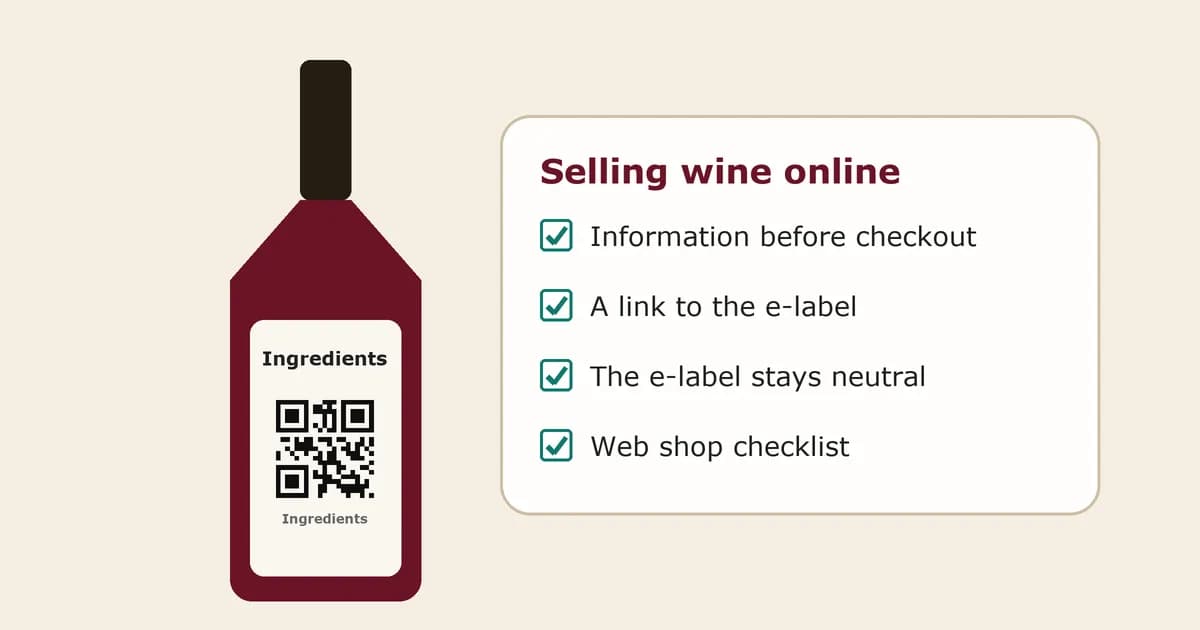
Wineries spent most of 2023 and 2024 fixing their back labels for the EU's ingredients and nutrition rules. Fewer looked at their web shop, their marketplace listings or the order form in the trade price list. Yet a bottle bought online has to come with the same information as one bought in a shop, and the buyer has to be able to see it before they pay, not only when the case arrives. This guide covers what has to appear where when you sell wine online in the EU, how an e-label link can do the job on a product page, the mistakes that come up most often, and a short checklist for your shop.
Plain-language guidance, not legal advice. Check the European Commission's Q&A on wine labelling, the Commission's page on distance selling and your national authority's guidance for your own wines.
Two sets of rules meet in an online wine shop
Since 8 December 2023, wine produced for the EU market must give buyers a list of ingredients and a nutrition declaration. The amended CMO Regulation (Article 119) lets producers move the full list of ingredients and the full nutrition declaration to an electronic label reached by a QR code or similar link, as long as the energy value and any allergens stay on the physical label, the e-label is not shown alongside sales or marketing content, and no user data is collected or tracked.
Selling at a distance adds a second rule from the general Food Information to Consumers Regulation (Regulation (EU) No 1169/2011, Article 14). For prepacked food sold by distance communication, which covers a web shop, a marketplace, a printed catalogue with an order form or a phone order, all mandatory food information has to be available before the purchase is concluded, except the minimum durability date. It must appear on the material supporting the sale, such as the product page, or be provided through other appropriate means clearly identified by the seller, at no extra cost to the buyer. Everything mandatory must also be available again at delivery, which the bottle's own label covers.
Put together, that means the ingredients, the nutrition information and the other compulsory particulars for a wine need to be reachable from its product page before checkout, not only from the QR code on the bottle.
What has to be available before the buyer pays
The exact list depends on the wine and where it is sold, but for most still wines a product page should give the buyer access to:
- The legal name of the product, such as wine, sparkling wine or the protected designation.
- The list of ingredients, with additives and processing aids named as the rules require.
- The nutrition declaration, or at least the energy value with a clear route to the full table.
- Allergens, such as sulphites, egg or milk, shown clearly, not only inside a link.
- The actual alcoholic strength by volume and the nominal quantity.
- Any other compulsory particulars for that wine, such as the provenance, the bottler or producer, and the sugar content term for sparkling wines.
The minimum durability date is the one item that can wait until delivery, and most wines do not need one anyway.
Can a product page link to the e-label?
Industry guidance says yes. The German Winegrowers' Association (DWV) factsheet on ingredients and nutrition for wine says an online shop can either show the ingredients list and nutrition table directly in the product presentation, or show a QR code or a link that opens them on an e-label. It applies the same logic to order forms and price lists that include an order form. The Commission's distance-selling page also allows the information to be given through "other appropriate means clearly identified" by the seller.
A link works well in practice because the e-label already exists, it is already correct for that wine, and the shop does not have to keep a second copy of the same data in sync. What matters is that the link is easy to find on the product page, clearly labelled (for example "Ingredients and nutrition"), opens without a login or a form, and leads to the e-label for that exact wine and vintage.
A small number of wineries prefer to show the full table directly on the product page as well. That is also fine, and some shoppers like seeing it without a click. If you do both, make sure the two never disagree.
The e-label stays neutral, the shop page does not have to
This is the part that trips people up. The rules say the e-label itself must not be displayed with sales or marketing content and must not track users. In its Q&A, the Commission's services say that putting the e-label on the producer's own website does not seem to comply, because a winery website normally carries commercial content and tracks visitors.
The product page in your shop is a sales page by nature, with prices, an add-to-cart button and usually analytics. That is fine for the product page. It means the ingredients and nutrition information should open on a separate, neutral e-label page, rather than being treated as one more tab of your shop with your tracking scripts running on it. If you choose to print the table on the product page instead, check the guidance in your market, because the rules here are still being interpreted.
Common mistakes in online wine listings
- Pointing the product page at the winery homepage instead of the e-label for that wine.
- Linking every wine in the shop to one generic e-label, or to last year's vintage after the numbers changed.
- Hiding allergens inside the link. Sulphites and any other allergens should be visible on the page itself, just as they stay on the bottle.
- Forgetting marketplaces and retailer listings. Whoever runs the listing is offering the wine for sale, so give each stockist and marketplace the e-label link for each wine and vintage.
- Forgetting the trade price list or PDF order form that buyers can order straight from.
- Putting the e-label behind a cookie wall, an age gate with tracking, or a newsletter pop-up.
Age gates deserve a word of their own. Many wine shops need one for other legal reasons. The e-label page linked from the bottle should not track users, so if your shop needs an age gate, keep it on the shop and keep the e-label page outside it.
A quick checklist for your web shop
- Every wine has its own e-label page, matched to the vintage and lot that is actually being shipped.
- Every product page has a clearly labelled link to that e-label, near the other product details.
- Allergens, alcoholic strength and volume are written on the product page itself.
- The same links are in your marketplace listings, retailer data feeds and trade order forms.
- When a new vintage goes on sale, the product page is switched to the new e-label on the same day.
- Someone has opened every link on a phone, without being signed in, in the last month.
Where the marketing QR code fits
The e-label has a narrow job. Everything else you want a buyer to see after they open the bottle, such as the story of the wine, food pairings, the wine club or a way to buy it again, belongs behind a second code on the back label. That is the two-QR back label many wineries now use: one neutral code for the legal information and one for the brand. Online sales close the loop here, because the marketing code can send a buyer straight back to your shop when the bottle is empty.
Frequently asked questions
Do I need to show ingredients and nutrition for wine sold online?
Yes, for prepacked wine sold to consumers at a distance in the EU. The mandatory information has to be available before the purchase is concluded, either on the product page or through another clearly identified means at no cost to the buyer.
Is a link to the e-label enough on a product page?
Industry guidance, including the German Winegrowers' Association factsheet, says a QR code or link to the e-label in the product presentation is acceptable. Make it clearly labelled and easy to find, and check your national authority's view.
Does this apply to wine sold through marketplaces and retailers?
The information has to be available wherever the wine is offered for sale at a distance. In practice, give every retailer and marketplace the right e-label link for each wine so they can show it.
Can my web shop be the e-label?
The Commission's services say an e-label placed on a producer's website does not seem to comply, because such sites usually carry sales content and track users. Keep the e-label on a neutral page and link to it from the shop.
What about wines produced before 8 December 2023?
Wine produced before that date can be sold until stocks run out under the earlier labelling rules. Many wineries still add e-label links for older stock because it keeps the shop consistent.
Where does Tapline fit?
Tapline is not your compliance check or your web shop. It powers the second code on the back label: a story page for each wine, a reorder button that sends buyers back to your online shop or stockist list, and scan counts per code, all editable after the labels are printed. On the Scale plan the page can be shown in several languages for export markets. The marketing page is never the legal e-label. Tapline can also host a separate, neutral e-label page for wine that you fill in yourself, and you are responsible for its accuracy. Tapline is built by Esipick, which has been building software for brands since 2013.
Related: what happens after the scan.
Related: two QR codes on one label.
Related: wine e-labels and new vintages.
Related: wine allergen labelling.
Related: how to write a wine ingredients list.
Related: wine bottle QR codes that turn into reorders.
Related: EU e-label rules for wine.
Related: pricing.