
Wine
What Must Stay on an EU Wine Label
A checklist of what still has to be printed on a wine bottle sold in the EU after the ingredients list and full nutrition table move behind a QR code.
By Ali Murtaza ·
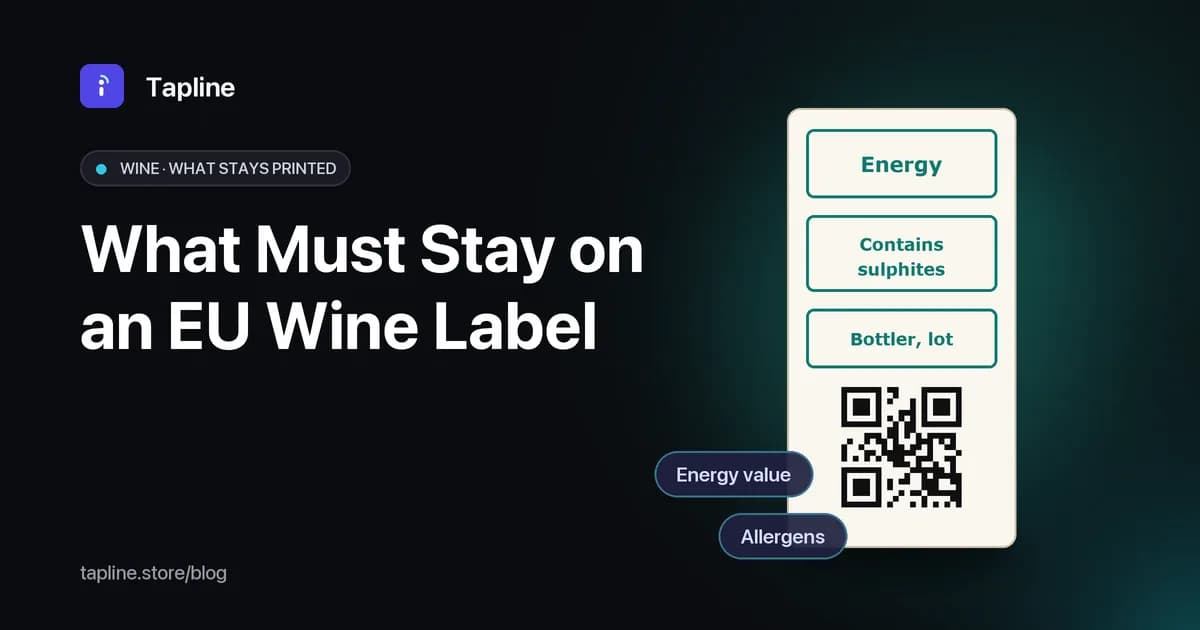
An EU e-label lets you move two compulsory particulars off the back label: the list of ingredients and the full nutrition declaration. Most of what had to appear on a wine sold in the EU still has to be printed on the bottle. This checklist is based on Article 119 of Regulation (EU) No 1308/2013, as amended by Regulation (EU) 2021/2117, Delegated Regulation (EU) 2019/33, and the Commission's questions and answers (C/2023/1190). It is general information for wineries and label printers, not legal advice.
What the e-label is allowed to carry
Since 8 December 2023, wine placed on the EU market must give a list of ingredients and a nutrition declaration. You can print both on the package, or provide them by electronic means identified on the label, usually a QR code. If the full nutrition declaration is online, the energy value still appears on the package. If the ingredients list is online, allergens still appear on the package. The page behind the code must not show sales or marketing information, must not collect or track user data, and must open directly, with no form or extra website in between.
A checklist of what stays printed
The Commission's Q&A (question 2) lists the compulsory particulars that share the same field of vision when everything is printed on the package. When you use an e-label, the QR code stands in for the ingredients list and the full nutrition table in that group. The energy value stays in the group.
| Particular | Where it goes |
|---|---|
| Category of grapevine product, plus "de-alcoholised" or "partially de-alcoholised" when that applies | On the bottle. Article 119(2) sets a narrow exception for certain PDO and PGI wines |
| PDO or PGI term and name | On the bottle, where the wine has one |
| Actual alcoholic strength by volume | On the bottle |
| Indication of provenance | On the bottle |
| Bottler, or for certain sparkling categories the producer or vendor | On the bottle |
| Importer, for imported wines | On the bottle; may sit outside the main field of vision |
| Net content | On the bottle |
| Sugar content, for sparkling wines | On the bottle |
| Energy value, per 100 ml | On the bottle, in the same field of vision |
| Full nutrition declaration | On the bottle, or on the e-label |
| List of ingredients | On the bottle, or on the e-label |
| Allergens, for example "Contains sulphites" | On the bottle; use "Contains …" if ingredients are online |
| Minimum durability date, for de-alcoholised wines | On the bottle; may sit outside the main field of vision |
| Lot identification | On the bottle; may sit outside the main field of vision |
| Ingredients QR code | On the bottle, same field of vision, headed with the word "ingredients" |
If you rely on the Article 119(2) exception to naming the category, read that article itself rather than assuming every PDO or PGI wine can drop the word "wine".
Article 40(1) of Delegated Regulation (EU) 2019/33 says the compulsory particulars must appear in the same field of vision, be readable without turning the bottle, be indelible, and stand out from surrounding text. Characters must be at least 1.2 mm high (Article 40(3)). When ingredients or the full nutrition table move online, the QR code and the energy value stay in that field of vision. Where the ingredients list is online, the allergens may sit elsewhere on the package, and so may the importer, the lot number and the minimum durability date on de-alcoholised wines (Article 40(2)).
Energy value and allergens stay on the bottle
Moving the nutrition table online does not remove the calorie line from the label. The energy value has to appear on the package, per 100 ml, in the same field of vision as the other compulsory particulars. Article 119(4) of Regulation (EU) No 1308/2013 allows the energy value to be expressed with the symbol "E" followed by the value. Give both kilojoules and kilocalories, with kilojoules first, as set out in Regulation (EU) No 1169/2011.
Sulphites, and egg or milk when they have to be declared, also stay on the bottle. If the ingredients list is printed on the package, emphasise the allergens inside that list. If the list is online, they must appear on the package after the word "Contains", using the terms in Delegated Regulation (EU) 2019/33, such as "sulphites" or "sulfites". They do not have to share the same field of vision as the QR code.
How the QR code itself must be marked
The Commission's Q&A (question 38) says a generic symbol such as an "i" on its own is not enough. Where the electronic information is the list of ingredients, a heading containing the word "ingredients" must sit with the code. The heading follows the language rules in Article 121. A printed web address is not enough: question 33 says buyers must scan a machine-readable code and reach the information immediately. Give the code enough size and contrast to scan on a curved bottle.
What must not appear on that e-label page
Article 119(4) and (5) of Regulation (EU) No 1308/2013 say the nutrition declaration and the ingredients list provided online must not be displayed with other information intended for sales or marketing purposes, and that no user data may be collected or tracked. The Commission reads a producer website or shop link as marketing, and says asking for consent does not make tracking allowed. If you also want a story, pairings or a reorder link, print a second, clearly separate QR code with its own wording, and keep it from taking space reserved for the compulsory particulars.
Bottler, importer, lot and extra national rules
The bottler, or for certain sparkling categories the producer or vendor, stays on the bottle. Imported wines also carry the importer. Lot identification stays on the package so a specific bottle can be traced. The importer and the lot number may appear outside the main field of vision. Some Member States also require extra health information on the bottle, such as a pregnancy warning; those particulars stay printed.
A simple back-label layout
- One legal block, readable without turning the bottle: category, PDO/PGI or provenance, alcoholic strength, bottler, net content and the energy value.
- In that same block, the ingredients QR code, labelled with the word "ingredients" in the language of the market.
- Allergens on the package, with "Contains", not necessarily in that same block.
- Importer and lot number on the package, where they apply; they may sit outside the main block.
- A second QR code further away if you want tasting notes, a story or a reorder link, with its own call to action, not words such as "Ingredients" or "Nutrition".
Send that brief to your designer and printer before you sign off the proof.
How Tapline fits
Tapline is not your legal statement or your compliance check. It powers the second code on the back label, the marketing one: a story page for each wine, a reorder button on the Growth plan and above that sends buyers to your shop or stockist list, and scan counts per code, all editable after the labels are printed. Pages in several languages are available on the Scale plan. The marketing page is never the legal e-label. Tapline can also host a separate, neutral e-label page for wine that you fill in yourself, and you are responsible for its accuracy.
See how it works for wineries on the wine page.
Related guides
- EU wine e-label rules explained
- Two QR codes on a wine label
- How to calculate wine calories
- Wine allergen labelling
- Wine ingredients list
- 10 wine e-label mistakes
FAQ
Can the energy value live only on the e-label?
No. If the full nutrition declaration is provided by electronic means, the energy value still has to appear on the package, per 100 ml, in the same field of vision as the other compulsory particulars.
Do allergens have to sit next to the QR code?
No. They must be on the package, but they do not have to share the same field of vision as the other compulsory particulars. If the ingredients list is online, put "Contains" and the name of the substance on the bottle.
Is a website address enough instead of a QR code?
No. The Commission's Q&A says a printed web address does not meet the rule. Buyers need a machine-readable code that opens the information directly.
Can I mark the e-label code with an "i" symbol only?
No. The Commission says a generic symbol such as an "i" is not enough. Use a heading that includes the word "ingredients", in a language the market understands.