Wine
10 Wine E-Label Mistakes to Fix Before You Print
Common EU wine e-label mistakes, from an "i"-only QR code to tracking, shop links and expiring pages, with what the Commission's Q&A says and how to fix each.
By Ali Murtaza ·
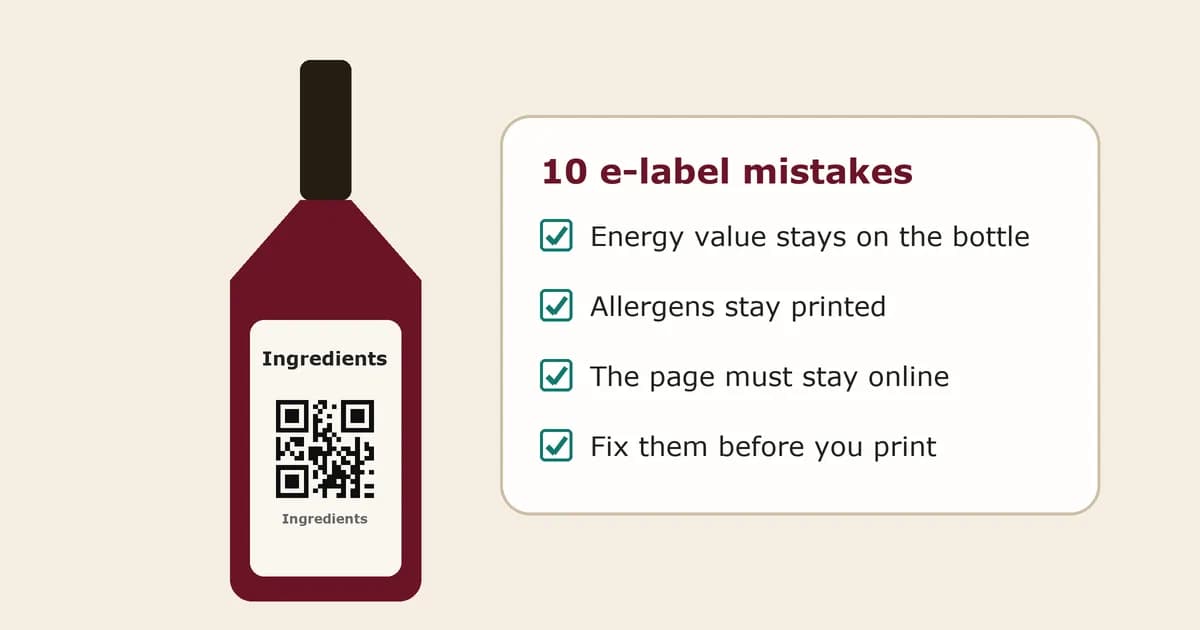
Most wineries know the basic deal for EU wine e-labels: the ingredients list and nutrition declaration can sit behind a QR code instead of on the back label. The trouble is in the details, and mistakes on the printed label are the expensive kind, because fixing them means a reprint or relabelling. This guide lists ten common wine e-label mistakes, what the rules and the European Commission's guidance say, and how to fix each one before your next print run.
Plain-language guidance, not legal advice. Check the European Commission's Q&A on wine labelling and your national authority's guidance for your own wines.
The rules in one paragraph
Regulation (EU) 2021/2117 amended the EU's common market rules for wine (Article 119 of Regulation (EU) No 1308/2013). Since 8 December 2023, wine placed on the EU market has to give a list of ingredients and a nutrition declaration. Both may be provided by electronic means identified on the label, as long as the energy value and any allergens stay on the bottle, the electronic page is not shown with sales or marketing information, and no user data is collected or tracked. The Commission set out how it reads these rules in a notice published on 24 November 2023 (C/2023/1190).
Source: European Commission Q&A on the new EU wine labelling provisions (EUR-Lex).
1. Marking the code with only an "i" symbol
Many early labels put only the "i" information symbol next to the QR code. The Commission's guidance says generic terms or symbols like an "i" are not enough on their own. If the code leads to the ingredients list, the label needs a heading with the word "ingredients", just as a printed ingredients list would have. The symbol can stay next to the word; it just cannot replace it. The word follows the same language rules as the other compulsory particulars on the label.
2. Putting the code where buyers cannot see it with the other particulars
The QR code that replaces the ingredients list or nutrition declaration has to appear in the same field of vision as the other compulsory particulars, such as the alcoholic strength, net volume and category of the wine. That means legible together without turning the bottle. A code on the neck or the far side of a wraparound label fails this.
3. Moving the energy value or allergens off the bottle
Putting the full nutrition table online does not remove the energy value from the label. It stays on the bottle, per 100 ml, in the same field of vision as the other compulsory particulars, and the rules allow it to be shown with the symbol "E" followed by the value. Allergens such as sulphites, or egg and milk when they have to be declared, also stay printed on the bottle when the ingredients list moves online. They do not have to sit in the same field of vision, but they cannot live only on the e-label.
4. Linking the code to your website or shop
The Commission's Q&A says that does not seem to meet the rules, because a producer's website usually carries sales and marketing content and usually tracks visitors. It also says that a link to an e-commerce site or winery website is a marketing purpose. The e-label page should be a separate, neutral page that shows the legal information and nothing that encourages a purchase.
5. Adding analytics, cookie banners or consent pop-ups
The rule on user data has no exceptions. The Commission says consent cannot make tracking acceptable, so a cookie banner that asks permission does not solve the problem. It also expects the code to take buyers straight to the information, without forms, queries or intermediate pages. Analytics scripts, chat widgets and age gates all need to go.
6. Making the e-label page look like an advert
Neutral means more than leaving out a buy button. The Commission reads "sales or marketing purposes" to include indirect persuasion: designs that add visual or sonic appeal, appealing phrases and commercial language. Tasting notes, awards and vineyard photos belong on your marketing page. The e-label page should show the wine's name so buyers know they reached the right page, then the ingredients and nutrition information, clearly laid out.
7. Printing a web address instead of a code
A short URL on the label is not a substitute. The Commission states that a website address printed on the label does not fulfil the obligation, because the information must be reachable through a machine-readable code that a smartphone can scan to open the information directly.
8. Using one page for several different wines
Several wines can share one site, but each label's code has to lead unambiguously to the information for one specific wine, covering one or more batches of it. A range page where buyers pick their wine from a menu risks showing the wrong numbers. One page per wine, and per vintage when the figures change, is the safer pattern. Our post on e-labels and new vintages covers when a new page is needed.
9. Letting pages break, change or expire
The Commission expects the e-label to stay available at least as long as the wine can reasonably be expected to remain suitable for drinking under normal storage, and the business responsible for the food information stays responsible for its presence and accuracy. The usual failures are overwriting a live page for the next vintage, a lapsed subscription that kills the code, and short links that disappear. Ask any provider what happens to your pages if you stop paying.
10. Adding a second code that confuses buyers
A second QR code for marketing is allowed, provided it does not mislead or confuse buyers and does not take space away from the compulsory particulars, including the e-label code. The mistake is two codes that look identical with no words next to them, so buyers cannot tell which is the legal information and which is the story. Give each code its own words, such as "Ingredients and nutrition" next to one and "Story and reorder" next to the other, and keep them visibly separate.
A quick pre-print check
- The e-label code has the word "ingredients" (or a heading naming the nutrition declaration) in the right language next to it.
- The code, the energy value and the other compulsory particulars can be read without turning the bottle.
- The code opens the e-label directly, with no website, shop, form or age gate in between.
- Each wine, and each vintage with different figures, has its own page.
- A second marketing code, if you use one, has different wording and its own space.
- Your printer has scanned a proof of both codes on the real label stock.
FAQs
Is the "i" symbol banned on wine labels?
No. The Commission's guidance says the symbol is not sufficient on its own. You can print it next to the word "ingredients", but not instead of it.
Can the e-label QR code be a sticker?
The Commission's guidance says the information must still meet the normal labelling rules whether or not the code is on a sticker, and labels must not be easily removable. A sticker applied in the same field of vision that cannot easily be peeled off is the cautious approach.
Can I fix an e-label mistake after the bottles are printed?
Mistakes on the page itself, such as a wrong figure, can be corrected on the page so it matches the bottle. Mistakes on the printed label, such as a missing "ingredients" heading or a missing energy value, cannot be fixed online. Ask your national authority how they want existing stock handled.
Who checks wine e-labels?
The national authorities that already control wine labelling in each EU country, according to the Commission's Q&A.
Where does Tapline fit?
Tapline is not your legal statement or your compliance check. It powers the second code on the back label, the marketing one: a story page for each wine, a reorder button that sends buyers to your shop or stockist list, and scan counts per code, all editable after the labels are printed. On the Scale plan the page can be shown in several languages for export markets. The marketing page is never the legal e-label. Tapline can also host a separate, neutral e-label page for wine that you fill in yourself, and you are responsible for its accuracy. Tapline is built by Esipick, which has been building software for brands since 2013.
Related: what happens after the scan.
Related: two QR codes on one label.
Related: EU e-label rules for wine.
Related: wine e-label privacy: no tracking, cookies or ads.
Related: wine allergen labelling.
Related: wine label QR code size and print specs.
Related: wine e-labels and new vintages.
Related: how to choose a wine e-label generator.
Related: pricing.